|
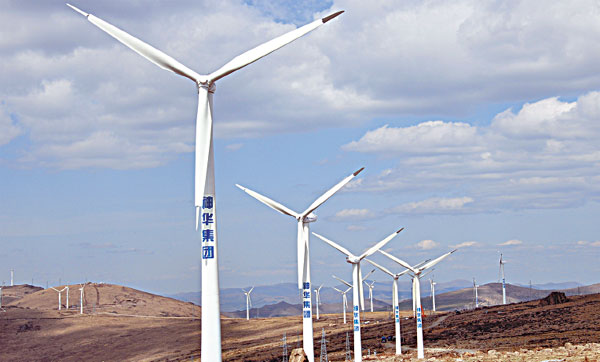
The wind field of Guohua Energy Investment Corp generates electricity in Chicheng county in Zhangjiakou. Provided to China Daily |
Zhangjiakou has the best air quality of any city in northern China, but as well as having clean air it also is a major supplier of clean energy.
The output from its wind and solar power installations helps to feed the growing demand for energy from neighboring Beijing.
Zhangjiakou started to build three new converting stations, which change DC current to AC current, and four transmission lines last March.
They will help to smooth out the distribution of power to the capital and other cities and reduce the number of wind generation hours wasted because of limited transmission capacity.
"Zhangjiakou has grown into a major center for wind and solar power generation," said Shen Quanmin, director of the city's economic planner, the development and reform commission. "The installed capacity reached 6.5 million kilowatt-hours at the end of 2014."
Zhangjiakou accounts for 4.6 percent of the country's total land-based wind power resources. The clear skies enable the city to generate solar energy for 1,500 to 1,600 hours every year, the second highest level nationwide.
The city has attracted investment from both the government and companies wishing to exploit green resources as the country works to cut its greenhouse gas emissions.
The largest of hundreds of projects that have been established is a national pilot hybrid plant set up in 2009 with a total investment of 9.5 billion yuan ($1.5 billion). The project utilizes wind and solar power jointly, and since the first phase was completed in 2011, the plant has transmitted 770 million kWh of green power.
The project has become the largest solar power center in the world, and the first to transmit 1 million kW of power in China.
"The technologies used by the plant for wind-photovoltaic hybrid generation, power storage and other related activities are the most advanced in the world," said Shen.
The power generated from wind accounted for only 2.5 percent of the country's entire output in 2013. However, the wind and solar power industries are likely to experience a boom as the campaign to reduce air pollution continues.
The National Development and Reform Commission said last April that by this year, wind power would account for 10 percent of electricity consumption on the Beijing-Tianjin-Tangshan grid, a major part of the national grid serving northern China.
The figure will rise to 15 percent by 2017, the top national economic planner said.
Shortly after these projections were released, Zhangjiakou finalized a huge contract involving investment of 90 billion yuan in a solar power project.
Many plants in Zhangjiakou have increased their capacity. For example, Guohua Energy Investment Co plans to build more wind-photovoltaic hybrid plants in the city as well as elsewhere in Hebei, raising its total installed capacity to 2 million kWh by 2020.
Zhang Fan, assistant to the corporation's general manager, said, "Our expansion is based on a positive view of the city and the promising future of the wind-photovoltaic hybrid industry."
H owever, the city's limited transmission capacity has restricted the rapid growth of green power and cut the profits of power plants. Annual profits fell to around 10 percent of total revenues last year, the lowest level in the past decade, Zhang said.
A private wind power plant found it impossible to make any profit.
Liu Mingwu, deputy manager of Hebei Huadian Guyuan Wind Power, said, "We missed out on profits of at least 120 million yuan last year during periods when we stopped generating power after we were given notice that the grid could not take our output."
At other times, the company generated power but was unable to sell it to the country because of the limited transmission capacity.
It is expensive to store power because of the huge investment needed to set up the necessary facilities.
The new converting stations and transmission lines will increase the city's capacity by 2 million kWh annually.
Liu added, "As long as we have smooth transmission channels, we will invest more in wind and solar power."


Copyright 1995 - . All rights reserved. The content (including but not limited to text, photo, multimedia information, etc) published in this site belongs to China Daily Information Co (CDIC). Without written authorization from CDIC, such content shall not be republished or used in any form. Note: Browsers with 1024*768 or higher resolution are suggested for this site.
License for publishing multimedia online 0108263 Registration Number: 130349