First Person
Why China lost the war, even with a modern fleet
CHEN YUE
A historian who has been studying the First Sino-Japanese War for 15 years.
With its battleships and cruisers made in Europe and sailors trained there, the Beiyang fleet was the most powerful naval power in Asia when it was founded in 1888.
But by the war in 1894, it had been surpassed by the Japanese navy.
Outdated battleships and lack of ammunition became a fatal weakness of the fleet. Low-quality coal and aging equipment became liabilities in fierce battles.
We could say China lost the war because of poor hardware. But fundamentally, China's incomplete modernization caused the failure. In almost every field including its political, military, education and economic systems, China had not finished reforming. That's why we lost to a fully modernized Japan. The world taught China the truth about survival of the fittest in a cruel way. Modernization was the only way of surviving in a world ruled by the law of the jungle.
AS TOLD TO PENG YINING
Life of Philo Norton McGiffin
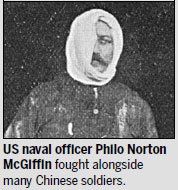
Born in 1860 in Pennsylvania, Philo Norton McGiffin entered the US Naval Academy at the age of 17. His great-grandfather was a soldier in the Revolutionary War and his father served in the Mexican War and the US Civil War.
After graduation, McGiffin failed to receive a commission in the US navy, so he went to China's newly founded fleet for employment.
China's Viceroy Li Hongzhang interviewed him for the post.
In a letter to his mother after the interview, he wrote that Li "looked at me and asked, 'How old are you?'"
"When I told him I was 24 I thought he would faint - for in China a man is a boy until he is over 30. He said I would never do - I was a child. I could not know anything at all. I could not convince him, but at last he compromised - I was to pass an examination at the Arsenal at the Naval College, in all branches, and if they passed me I would have a show."
McGiffin indeed passed all the tests and got a position commanding a training ship. He also hired a Chinese instructor and was able to converse fluently in Chinese in a year and a half.
Before the Battle of the Yalu River in 1894, he was deployed on the battleship Zhen Yuan. In his memoir and essays, McGiffin told many stories of fighting alongside Chinese soldiers, and described details of the battle, which are rare in official documents.
Suffering from mental instability due to wounds received at the battle of the Yalu, McGiffin committed suicide in a US hospital in 1897.
The back of his tombstone carries the inscription:
"This tablet is erected in memory of a Brave Man who loved his own but gave his life for an alien flag."
Foreign officers in Chinese battles
The Battle of the Yalu River: Sept 17, 1894
Germany
? Constantin von Hanneken
? J. Albrecht
? Hoffmann
UK
? Thomas Nicholls
? William Ferdinand Tyler
? Alexander Purvis
US
? Philo Norton McGiffin
The Battle of Weihaiwei: January-February, 1895
Germany:
? Schnel
? Leonald Parker
UK
? McClure
? William Ferdinand Tyler
? Kirk
? Howard
? Thomas Mellows
? Thomas Hasting
? Charles Clarkeson
? Graves
? Rolbert Walpole
? Samuel Wood
Incomplete list provided by Wang Jihua, deputy director of the museum of the First Sino-Japanese War. He can be reached at: jiawumuseum@163.com


Copyright 1995 - . All rights reserved. The content (including but not limited to text, photo, multimedia information, etc) published in this site belongs to China Daily Information Co (CDIC). Without written authorization from CDIC, such content shall not be republished or used in any form. Note: Browsers with 1024*768 or higher resolution are suggested for this site.
License for publishing multimedia online 0108263 Registration Number: 130349