 |
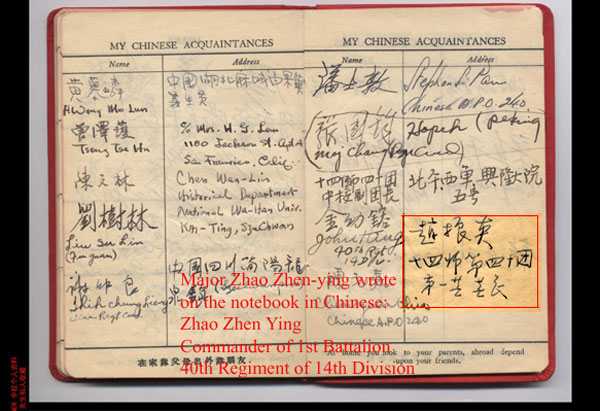
| Before John Gardner left China, Zhao Zhenying signed the US liaison officer's red diary. Zhao's signature is at the bottom right of the page. CHINA DAILY |
Back from the dead
"How could it be possible? Weren't they all dead?" Yan said. "However, I decided to give him the benefit of doubt and talked directly to the old man over the phone. His knowledge about my grandfather and the CBI Theater surprised me."
Two month later, Yan left his home in Shenzhen, Guangdong province and visited Zhao at his apartment in Beijing. "We talked almost nonstop for two days, while all the pieces started to fall into place," Yan said. "This man had been a battalion commander in the New 6th Army, and fought in the CBI between 1944 and 1945.
"He also told me his battalion had been in charge of security at the ceremony of surrender in Nanjing in September 1945," he said.
When he heard that, Yan showed Zhao a file photo. "I don't know who took it. But this image was probably the most widely distributed one about the event," he said.
The photo showed seven Japanese representatives directly facing their Chinese counterparts, and behind them on the left edge of the picture, was a young Chinese officer wearing riding boots and white gloves.
"Zhao, who was seeing this photo, or any image of the surrender, for the first time since 1945, pored over it for a long while. Slowly, he pointing at the young officer and murmured to himself, 'That was my position...'," Yan recalled. "He said nothing else, but it was more than enough to set me on the track."
In May 2009, Neal Gardner, whose father fought as a member of the New 6th army, traveled from his home in Oklahoma to meet Zhao. Footage of their meeting shows the well-built US resident giving the frail old man a hearty embrace.
"This was a man who had known my father over 65 years earlier and I was making his acquaintance," Gardner said. "It was like meeting a long lost relative. I cried out in delight and happiness."
He presented Zhao with a CBI collar badge. The old soldier's had been lost, or burned, during the turbulent years of the "cultural revolution" (1966-76), along with any other items that could bear witness to his personal history.
Unspoken history
"I fought the Japanese as a soldier of the Nationalist Army, under the then-Nationalist government. But then the civil war broke out between the Chinese Nationalists and the Communists. With the triumph of the Communists and the founding of the People's Republic of China, my veteran's background suddenly became a potential landmine, something I would try anything to avoid," said Zhao, who admitted he destroyed everything that could "incriminate" him. "For more than four decades, I had never talked to anyone about those experiences-not my neighbors, my children or my grandchildren."
But memories are indestructible. On July 23, 1937, Zhao, a 20-year-old Beijing native, embarked a train and left his hometown. "White flags were hanging above the train (to indicate that the passengers were civilians, not military personnel), and as it crossed the Marco Polo Bridge, I pressed my face against the window and saw Japanese soldiers looking in our direction through their telescopes," Zhao said. "Street battles were about to break out and Beijing was soon lost."
Eventually, Zhao arrived in Jiangxi Province in East China, where he trained at a branch of the Whampoa Military Academy, the country's first modern military college. Between 1939 and early 1944, he was a member of the Nationalist Army and fought the Japanese in many parts of China.
"Then in March, 1944, our troops were flown to India," he said, referring to his days in the CBI theater, where he met and befriended many Allied officers who had been sent to assist the Chinese army after the attack on Pearl Harbor in Dec 1941. Neal Gardner's father was among their number. "They were mostly liaison officers, and since I spoke some English, it didn't take long before we became close," Zhao said. "While we were in Burma, I shared a tent with Danile Pancake, a US army captain. It rained a lot and I still remember him chanting in his baritone voice: 'Rain, rain, go away. Come again some other day...'"


Copyright 1995 - . All rights reserved. The content (including but not limited to text, photo, multimedia information, etc) published in this site belongs to China Daily Information Co (CDIC). Without written authorization from CDIC, such content shall not be republished or used in any form. Note: Browsers with 1024*768 or higher resolution are suggested for this site.
License for publishing multimedia online 0108263 Registration Number: 130349