 |
|
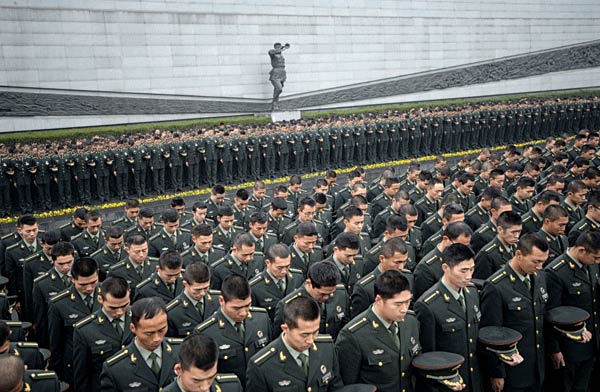
A symbolic total of 1,213 soldiers remember the deaths of Nanjing Massacre victims at the memorial hall on Wednesday. On Dec 13, 1937, the Japanese army occupied Nanjing and killed more than 300,000 Chinese civilians and unarmed soldiers, according to Chinese historical documents. [Photo by Cui Xiao / For China Daily] |
NANJING -- Nanjing in East China's Jiangsu province has a history spanning thousands of years that is stained by invasions and killings, but the Nanjing Massacre, or the Rape of Nanking, eclipsed them all.
The freezing winter of 1937 saw the invading Japanese army kill 300,000 people within six weeks. One person was killed every 12 seconds.
One of the first printed accounts of the Nanjing Massacre at that time was a report by Frank Tillman Durdin, a correspondent for The New York Times.
"Wholesale looting, the violation of women, the murder of civilians, the eviction of Chinese from their homes, mass executions of prisoners of war and the impressing of able-bodied men turned Nanking into a city of terror," he wrote.
This Saturday will be the first National Memorial Day for Nanjing Massacre Victims. Before the event, Xinhua reporters visited the city to get an insight into what happened on and after Dec. 13, 1937.
THE DAY THE JAPANESE TOOK NANJING
Chang Zhiqiang, now 86, often reflects on the happy days before the Japanese invasion. "Nanjing was a prosperous city," he said. "Life was full of fun. There were storytellers, acrobats and magicians."
His father ran a small grocery store. "He was quiet and reserved," he said, "my mom was very clever and made all kinds of shoes for children. Everyone liked her."
As the Japanese army approached Nanjing, refugees from the north flooded in, while locals fled. A telegram sent on October 28, 1937 by Kouki Hirota, then the Japanese Foreign Minister, suggested that there were more than 530,000 people still left in the city.
Chang recalled how his parents took him, his elder sister and five younger brothers to try and flee the city, but stopped half way to the Yangtze River.
"There were not enough boats," he said.
So they decided to wait another day, but, unfortunately, the next day was to be the day the city was captured.
In his book, the "Fabrication of the Nanjing Massacre", Masaaki Tanaka who was the secretary to a Japanese general in WWII, claimed that on the day the Japanese marched into Nanjing, 120 journalists and photographers did interviews across the city, but none saw any bloodshed.
Chang's memory of that day, however, is very different.
"They shot from the gate tower. The city became a sea of fire and smoke," he said.
Several Japanese soldiers entered the house where Chang's family were hiding. Chang remembered one man fighting with the intruders with nothing but his bare hands, so that others could have time to escape.


Copyright 1995 - . All rights reserved. The content (including but not limited to text, photo, multimedia information, etc) published in this site belongs to China Daily Information Co (CDIC). Without written authorization from CDIC, such content shall not be republished or used in any form. Note: Browsers with 1024*768 or higher resolution are suggested for this site.
License for publishing multimedia online 0108263 Registration Number: 130349