 |
|
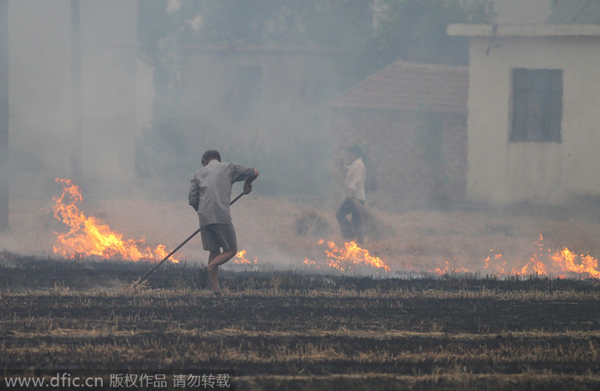
Straw stubble is burnt off at a farm on Xintongjue Highway in Nantong city, East China's Jiangsu province. The burning of stubble is a contributory factor in the notorious smog that lingers in China. [Photo/IC] |
BEIJING - Excessive use of "unclean" energy, not vehicle emissions or straw burning, is the main contributor to China's recurrent smog, a China Youth Daily report quoted a Chinese expert as saying on Monday.
Speaking at a symposium organized by the China Association for Science and Technology, Zhang Xiaoye, director of an atmospheric composition committee under the China Meteorological Society, said that though straw burning, fireworks and vehicle emissions have contributed to air pollution, "excessive use of 'unclean' energy is the real culprit."
According to the report, Zhang used "unclean" energy to refer mainly to coal.
"Coal and other unclean energy sources are the number one contributor to China's smog," he said, adding that vehicle emissions may come second, especially in big cities.
Citing PM 2.5 readings recorded in early November, when Beijing hosted the Asia-Pacific Economic Cooperation (APEC) meetings, Zhang said the figures showed a considerable drop of 35 percent.
He said only ten percent of the pollution reduction came from the odd-and-even license plate vehicle restrictions, which reduced daily traffic by up to 11.7 million cars, whereas the rest was the result of cuts in coal burning in Beijing's neighboring regions starting Nov. 6.
Many parts of China have been regularly plagued by choking smog since 2013. The situation in north China is particularly serious.
To ensure good air quality for the APEC meetings, nearly 4,000 factories were ordered to close or curb production in Hebei during the week-long meetings.
As a result, the Beijing sky remained blue during APEC despite predictions otherwise, with daily PM 2.5 density in the period falling to 43 micrograms per cubic meter, prompting Chinese netizens to coin the phrase "APEC Blue" to describe the clear sky.
But since the lifting of the bans, Beijing has reported several spells of mild to serious air pollution, with PM 2.5 density reaching 224 micrograms per cubic meter in Beijing on Tuesday.
Special:


Copyright 1995 - . All rights reserved. The content (including but not limited to text, photo, multimedia information, etc) published in this site belongs to China Daily Information Co (CDIC). Without written authorization from CDIC, such content shall not be republished or used in any form. Note: Browsers with 1024*768 or higher resolution are suggested for this site.
License for publishing multimedia online 0108263 Registration Number: 130349