 |
|
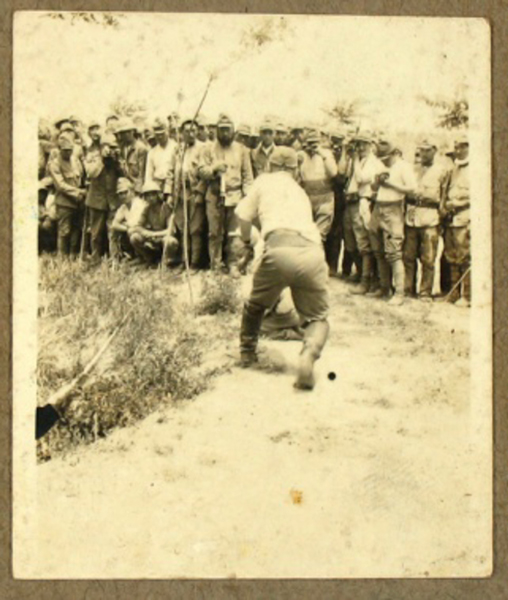
The second episode of a serial documentary on the Nanjing Massacre was released on Monday ahead of the inaugural National Memorial Day for Nanjing Massacre Victims. [Photo/Xinhua] |
BEIJING - The second episode of a serial documentary on the Nanjing Massacre was released on Monday ahead of the inaugural National Memorial Day for Nanjing Massacre Victims.
Japanese troops captured Nanjing, which at the time was the capital city, and started a bloody campaign on Dec. 13, 1937, which was to last for more than 40 days. More than 300,000 Chinese soldiers, who had laid down their arms, and civilians were murdered.
The second episode, which was published on the State Archives Administration's website, was accompanied by nine archive photographs taken by Japanese soldiers.
The images recorded the brutal beheading of several Chinese captives, some of whom were uniformed soldiers and others clearly civilians. Many of the photos also featured dozens of Japanese soldiers, either watching attentively or shifting their eyes.
According to the documentary, the photographs belonged to a Japanese officer who dropped off two rolls of film to be processed in Nanjing in January 1938.
Luo Jin, who developed the negatives, was shocked to see that the images featured the slaughtering, harassing and raping by Japanese soldiers.
He secretly printed 16 of the negatives and hid them until the Japanese fell. The images were submitted to the Kuomintang Government as evidence of the massacre.
Monday's episode also included several letters written from Chinese based overseas to relatives in China about the foreign media coverage of the massacre.
On man, surnamed Lai, wrote from London to his brother in central China's Hunan province about the allegations of mass rape in Nanjing.
"I learned from yesterday's newspaper that Japanese soldiers had raped thousands of Chinese women in Nanjing, including 12-year-old girls. Many were killed after being raped. This was extremely inhuman," he wrote.
Another letter, from a person named Zhi in Germany to Yuan in North China's Tianjin city, was equally chilling: "What the Japanese did in Nanjing made my hair stand. They had raped a lot of women, including nuns. Even a 14-year-old girl was not spared."
He continued, "I read a letter from a British missionary in Nanjing in a newspaper. He said he had repeatedly pled with the Japanese army to stop."
Ironically, it is thanks to the Japanese that these letters survived.
During the invasion, the Japanese installed a mail censoring system, intercepting and destroying anything deemed improper information and included examples of these "improper letters" in their weekly or monthly reports.
When the Japanese were defeated in 1945, these reports became vital evidence of Japan's war crimes.
More episodes will be published in the week preceding National Memorial Day for Nanjing Massacre Victims, which will fall on Dec. 13.
Japan invaded Northeast China in September 1931, followed by full-scale invasion that started on July 7, 1937. Around 35 million Chinese soldiers and civilians were killed or injured in the war against Japanese invasion that continued until 1945.


Copyright 1995 - . All rights reserved. The content (including but not limited to text, photo, multimedia information, etc) published in this site belongs to China Daily Information Co (CDIC). Without written authorization from CDIC, such content shall not be republished or used in any form. Note: Browsers with 1024*768 or higher resolution are suggested for this site.
License for publishing multimedia online 0108263 Registration Number: 130349