|
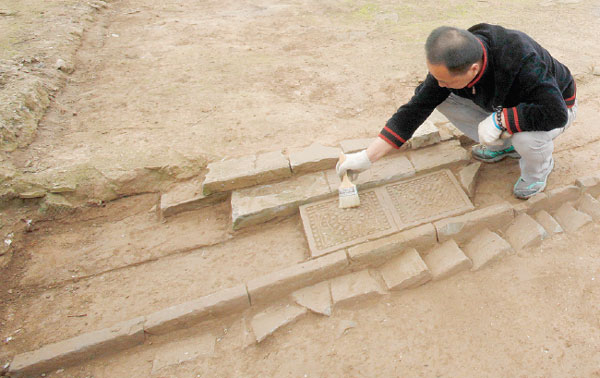
The excavation team member works on the site of the ruins of Daming Palace. Provided to China Daily |
According to excavation team leader Li Chunlin, of the Chinese Academy of Social Sciences' Archaeology Institute, a 50-square-meter room has been unearthed in the west of the office ruins, and a relatively small room in the north of the office has also been found.
The team began excavating in 2010 a 5,200-sq-m area northwest of Huanyuan Hall and Xuanzheng Hall, the main buildings of the Daming Palace, the Tang Dynasty imperial palace. The area was made the focal point of a projected five-year excavation from 2011 to 2016, approved by the State Administration of Cultural Heritage, after many Tang cultural relics were found there.
Two excavations, in 2011 and 2012, unearthed ruins of roads, walls, channels and an incomplete yard, said Gong Guoqiang, another excavation team leader.
Gong said that the third excavation on the site began in a 1,500-sq-m area in October, and the complete layout of the yard should be unearthed by the end of the year.
Experts say the room recently discovered might be the zhongshu sheng, because it was located in the west side of the Xuanzheng Hall. Historical records indicate that the zhongshu sheng and menxia sheng were in the west and east sides of the hall.
Archaeologists found hundreds of artifacts around the office ruins, and many of them bore inscriptions in Chinese characters reading "official" that were used by imperial officials.
During the Tang Dynasty, the central government set three sheng, or offices, and six ministries. The zhongshu sheng was for drafting and issuing imperial edicts, the menxia sheng was for checking such edicts, and the shangshu sheng was for managing government affairs. The three sheng were directly under the management of the emperor and were higher than the six ministries.
Such ruins of central governmental offices have never before been discovered, Gong said, and they provide information for the research of the ancient government structures.
The ruins of Daming Palace are located in the northern suburban of Xi'an, capital of Shaanxi province. The city was the Tang Dynasty's capital. It covered 84 sq km and had a population of over 1 million. In ancient times, it was called Chang'an and was one of the largest and most prosperous international cities in the world.
malie@chinadaily.com.cn


Copyright 1995 - . All rights reserved. The content (including but not limited to text, photo, multimedia information, etc) published in this site belongs to China Daily Information Co (CDIC). Without written authorization from CDIC, such content shall not be republished or used in any form. Note: Browsers with 1024*768 or higher resolution are suggested for this site.
License for publishing multimedia online 0108263 Registration Number: 130349