BEIJING - ?China's top legislature adopted a Counterespionage Law Saturday aimed at more comprehensive state security.
Members of the Standing Committee of the National People's Congress (NPC) passed the bill through a vote at the close of the bi-monthly legislative session attended by top legislator Zhang Dejiang.
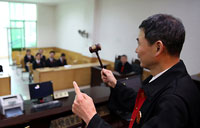 |
| China ratifies national Constitution Day? |
The bill specifies espionage's definition: foreign organizations and individuals who conduct espionage activities or who instigate and sponsor others in conducting them will be punished, as will domestic organizations and individuals who spy on the country for foreign organizations and individuals.
It grants national security agencies the authority to ask an organization or individual to stop or change activities considered harmful to national security. If they refuse or fail to do so, the agencies will be entitled to seal or seize related properties.
The agencies are also entitled to seal and seize any device, money, venue, supplies and other properties that are related to espionage activities, according to the bill.
They will be either confiscated by national security agencies or handed over to judicial departments.
The illegal income and properties gained through knowingly hiding and fencing properties related to espionage will be confiscated, the bill says.
However, lawmakers suggested regulating counterespionage power. It stipulates that "counterespionage work should proceed according to law, respect and ensure human rights, and guarantee the legal interests of citizens and organizations."
Information and material obtained for counterespionage work should only be limited in the field, and confidentiality should be ensured regarding state and commercial secrets and personal privacy, the law says.
It also bans illegally possessing espionage instruments, as defined by the state security department, which was added after lawmakers suggested that electronic devices like smart phones can also be used in espionage.
The law also rewrites articles that were not in line with other laws revised in recent years, including the Criminal Law and Criminal Procedure Law.
Taking effect in 1993, the National Security Law mainly regulates the work of the country's national security agencies, whose major duty is counterespionage. It has not been revised since then.
The National Security Law ceased Saturday after the new law was released, the bill says.
REDUCING SCOPE OF STATE SECRETS
While discussing the law's draft version, lawmaker Fu Ying, a former vice foreign minister, proposed reduction of the scope of state secrets.
Leaking confidential documents is one of the common law violations committed by government workers driven by profits, said the former diplomat who now chairs the NPC Foreign Affairs Committee.
Fu pointed out that standards for classified documents in China are "relatively low," and that some documents are classified as state secrets due to the nature of the department handling them, not because the content falls into the category of state secrets.
Official speeches have sometimes been deemed as confidential before the speeches were delivered or released, she said, adding they should be declassified after being made public.
China has been increasingly involved in many international events, with various documents to handle. "State secrets that are too widely ranged cannot be effectively managed," said Fu, also spokeswoman for the NPC annual session.
Amending the law is important as required by the country's demand for rule of law, she said.
Sun Baoshu, deputy head of the NPC Law Committee, said it is necessary to transform the National Security Law into the Counterespionage Law in order to "prepare for a comprehensive and fundamental state security law."
President Xi Jinping advocated an "overall national security outlook" at the first meeting of the central national security commission in April.
Xi stressed that the challenges China faces in maintaining national security today are more diverse than they have ever been, as it has seen complicated internal and external situations.


Copyright 1995 - . All rights reserved. The content (including but not limited to text, photo, multimedia information, etc) published in this site belongs to China Daily Information Co (CDIC). Without written authorization from CDIC, such content shall not be republished or used in any form. Note: Browsers with 1024*768 or higher resolution are suggested for this site.
License for publishing multimedia online 0108263 Registration Number: 130349