 |
|
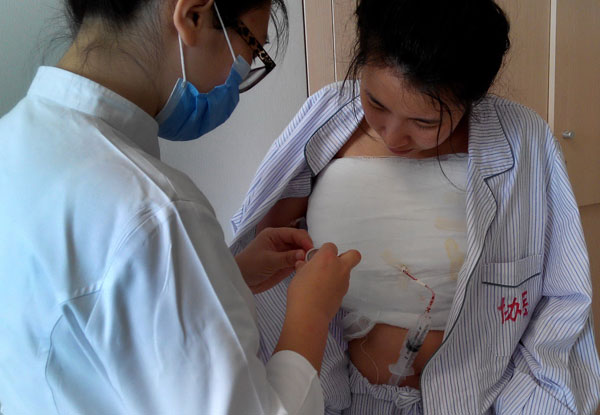
A patient undergoes an examination after surgery for breast cancer in a Beijing hospital. Zou Hong / China Daily |
However, experts said the ACS's recommendations are unlikely to be implemented in China for a number of reasons.
"If the recommendations were to be adopted, the cost of detecting each case, when spread over all the women in that age group, would be a staggering 1.25 million yuan ($204,000) per year. That means it would be impractical to use mammograms to screen all women aged 40 or older," said Sun Qiang, director of the breast surgery clinic at the Peking Union Medical College Hospital.
Breast size is another reason. "Most women in China are A or B cup. That's not ideal, because the testing equipment is actually designed for women with larger breasts, so some diagnoses could be inaccurate.
According to Guan Jinghong, a surgeon at the clinic, the density of breast tissue also presents a challenge to diagnosis via mammogram.
"Asian women have higher density breast tissue. When they have mammograms, both the tissue and calcification (an indicator of tumors) show up as white," she said. "However, women in Western countries have lower density breast tissue and their breasts contain more fat, and both their tissue and fat appear black under mammograms."
China has no national guidelines for the detection of breast cancer. The Peking Union Medical College Hospital played a leading role in pilot research from 2006 to 2010, but the recommendations made by the team have not been officially adopted.
Experts from the hospital collected data from 50,000 cases at 14 medical institutes nationwide, and formulated a risk-evaluation model for efficient, low-cost detection. Women deemed to be at risk under the model are sent for further tests, including mammograms and magnetic resonance imaging. According to Sun, the model would cut the cost of each case detected by mammogram to 320,000 yuan.
The model works by assessing factors that cannot change - including family history and genetic risks - plus variables, such as diet, smoking, and alcohol consumption. Environmental factors are taken into account too.
Other factors also play a role in determining the risks. For example, childless women, or women who had their first child after the age of 30, have a slightly higher risk of developing breast cancer.
"But the risk factors don't tell us everything. Having one, or even several, doesn't automatically mean you will get the disease. Even when a woman with certain risk-factors develops breast cancer, it's difficult to determine just how much those factors may have contributed to her illness," Guan said.


Copyright 1995 - . All rights reserved. The content (including but not limited to text, photo, multimedia information, etc) published in this site belongs to China Daily Information Co (CDIC). Without written authorization from CDIC, such content shall not be republished or used in any form. Note: Browsers with 1024*768 or higher resolution are suggested for this site.
License for publishing multimedia online 0108263 Registration Number: 130349