 |
|
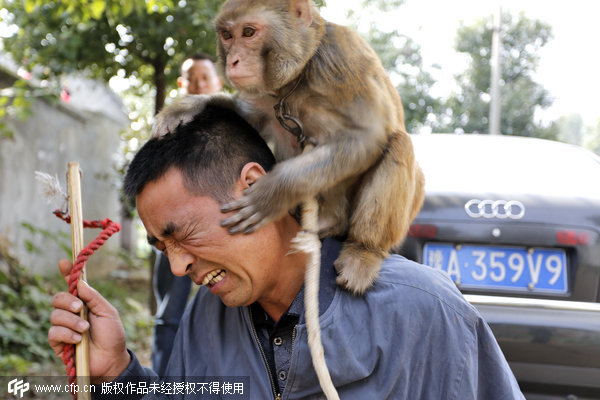
A monkey in a street show in Nanyang, Central China's Henan province, Oct 15, 2014. [Photo/CFP] |
Four months ago, police detained four trainers including Bao, as they performed with six monkeys on the streets of Mudanjiang, Heilongjiang province, because they did not have a wildlife transportation license.
Instead of taking advantage of the slow farming season, one of the best times for performances, Bao has decided to agonize at home alongside his monkeys.
In Bao's small village in Xinye county, Henan province, 2,000-plus km from where he was arrested, fellow performers hear about Bao's experience and feel his anguish.
A local court saw the case in late September and said Bao and his fellow trainers committed the crime of illegally transporting rare wildlife. But the court was lenient, allowing them to avoid criminal penalties.
When they were released, Bao found that one of his monkeys, the 12-year-old Adan, had died. He buried it in an unknown mountain, and left for home with a broken and perplexed heart.
"More cities crop up in the country, but we find fewer performing places for our monkey circus," said 51-year-old Bao.
The figure of the monkey, represented by Sun Wukong, the Monkey King in the classic novel Journey to the West, is traditionally popular among Chinese people.
Monkey circuses are a traditional art form in Xinye county and were listed as an intangible cultural heritage by Henan province in 2009. Their origin dates back over 2,000 years to the Eastern Han Dynasty (AD 25-220).
The circus does not need stages or spotlights. It only requires a vacant lot. Trainers and their monkeys travel around the country and perform difficult routines to amuse audiences, who give applause and money at their discretion.
But over the past three decades, this traditional art has faced a dilemma with China's rural and urban changes, experiencing conflict between traditional culture and modern civilization.
Vagrant lifestyle
Wang Zhongxu, a trainer from Xinye, regularly performs with his monkeys on the streets of Jingmen, Hubei province. When spotting a chengguan, or urban management officer, he's forced to quickly pack his belongings and move. Often, the chengguan are coming for him.
As a monkey performer, he has grown used to the vagrant lifestyle.
Railways, bus stations and vegetable markets are the ideal places for the circus. But as cities move their railway and bus stations to the suburbs, and vegetable markets are gradually replaced by closed-in supermarkets, "finding a proper vacant lot that can attract spectators but avoid chengguan is very difficult," he said.
Yu Cheng, 20, the youngest performer in the county, said: "I don't know. Perhaps I will find a job in some bigger city like other young people."


Copyright 1995 - . All rights reserved. The content (including but not limited to text, photo, multimedia information, etc) published in this site belongs to China Daily Information Co (CDIC). Without written authorization from CDIC, such content shall not be republished or used in any form. Note: Browsers with 1024*768 or higher resolution are suggested for this site.
License for publishing multimedia online 0108263 Registration Number: 130349