 |
|
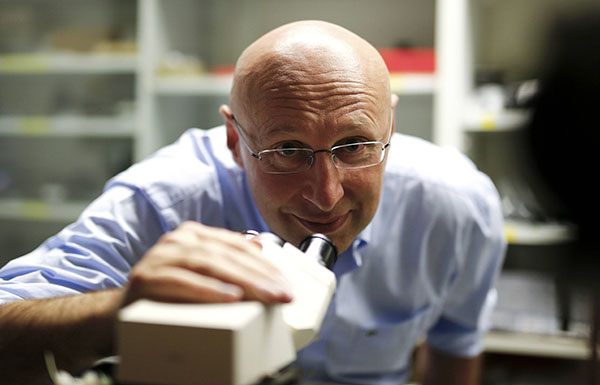
German scientist and Nobel prize winner Stefan Hell poses with a nanoscale microscope at the Max Planck Institute for Biophysical Chemistry in Goettingen October 8, 2014. US citizens Eric Betzig and William Moerner and Germany's Stefan Hell won the 2014 Nobel Prize for Chemistry on Wednesday for smashing the size barrier in optical microscopes, allowing researchers to see individual molecules inside living cells. [Photo/Agencies] |
STOCKHOLM - Two Americans and a German scientist won the Nobel Prize in chemistry Wednesday for finding ways to make microscopes more powerful than previously thought possible, allowing scientists to see how diseases develop inside the tiniest cells.
 |
| Nobel discovery opens window onto Alzheimer's disease |
 |
| Three scientists share 2014 Nobel Prize in Physics |
Working independently of each other, US researchers Eric Betzig and William Moerner and Stefan Hell of Germany shattered previous limits on the resolution of optical microscopes by using glowing molecules to peer inside tiny components of life.
Their breakthroughs, starting in the 1990s, have enabled scientists to study diseases such as Parkinson's, Alzheimer's and Huntington's at a molecular level, the Royal Swedish Academy of Sciences said.
"Due to their achievements the optical microscope can now peer into the nanoworld," the academy said, giving the 8 million-kronor ($1.1 million) award jointly to the three scientists for "the development of super-resolved fluorescence microscopy."
Betzig, 54, works at the Howard Hughes Medical Institute in Ashburn, Virginia. Hell, 51, is director of the Max Planck Institute for Biophysical Chemistry in Goettingen, Germany, and also works at the German Cancer Research Center in Heidelberg. Moerner, 61, is a professor at Stanford University in California.
"I was totally surprised, I couldn't believe it," said Hell, who was born in Romania. "Fortunately, I remembered the voice of Nordmark and I realized it was real," he added, referring to Staffan Nordmark, the academy's permanent secretary.
The Nobel judges didn't immediately reach Moerner, who was at a conference in Brazil. He found out about the prize from his wife after she was told by The Associated Press.
"I'm incredibly excited and happy to be included with Eric Betzig and Stefan Hell," Moerner told the AP.
For a long time optical microscopes were limited by, among other things, the wavelength of light. So scientists believed they could never yield a resolution better than 0.2 micrometers.


Copyright 1995 - . All rights reserved. The content (including but not limited to text, photo, multimedia information, etc) published in this site belongs to China Daily Information Co (CDIC). Without written authorization from CDIC, such content shall not be republished or used in any form. Note: Browsers with 1024*768 or higher resolution are suggested for this site.
License for publishing multimedia online 0108263 Registration Number: 130349