NEW YORK - "The major difference between America and China are that Chinese teachers, parents, children and administrators, they are all on the same page and work toward the same goal," Reina Joa, a math teacher at Brooklyn High School of the Arts, told Xinhua.
Curious about how teachers in Shanghai are trained and students taught, Joa, along with nine other public school teachers in New York City and NYU faculty, set on a ten-day professional development trip to Shanghai, China, in late July under an education program called "Science Education Without Borders".
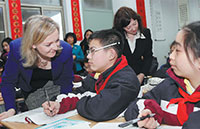
They visited top-notch schools in Shanghai, and talked with education officials and students to figure out differences between their respective schooling systems.
The education trip came amid debates on China's education system after Shanghai students came first in the Program for International Student Assessment, or PISA, test twice in a row. Some saw it as a success, others were skeptical.
At the symposium held in New York University on Saturday, the teachers shared what they gleaned from their time in China, and how they will implement their findings as they teach STEM (science, technology, engineering, and mathematics) subjects in their NYC classrooms. New York University's Steinhardt School of Culture, Education, and Human Development hosted the event.
"I was struck at the way that schools in China are felt, how differently they are felt in American," said Josh Wickline, a biology, chemistry and physics teacher at a performing arts high school in Manhattan.
The conflict in American high school is palpable, he said. "You can feel the conflict between teachers and administrators, between teachers and parents, between teachers and students."
"In China, the sense of cooperation between government, teachers, administration, students and parents is very real and I think that has a lot to do with their great success."
Asked about what good experience they will bring back to schools, Joa said: "The first thing would be teachers' professional development, or professional learning."
Joa, who gave a joint presentation with Daine Weisen, an elementary school science teacher, on professional development for teachers in China, listed several merits of this area in Shanghai, such as weekly meetings of teacher lesson planning groups for sharing methodologies, teacher research groups to solve problems and determine best practices, mentor relationships with master teachers, among others.
"Because teachers in China only teach 10-13 hours a week out of their whole 40-hour week, there are weekly meetings for lesson planning. And in the United States, unless you meet during your lunch you're not meeting with your colleagues because you're teaching," Weisen said.
The education "eco-system" in Shanghai seems to be running flawless with all the stakeholders cooperating toward one direction, but some threw out a hard question: "Is something missing?"
Lauren Verdeflor, who teaches the natural and physical sciences at Bronx Lab school, believed that Chinese students lacked the freedom to choose the future path.
Each year, a group of 10 to 12 teachers will receive scholarships to travel during the summer as Astor International Travel Fellows with NYU Steinhardt faculty. The program rotates among NYU's global academic centers and campuses, and program themes range from STEM education to special education, literacy, art and music education, and bilingual education.
In 2015, the program will take teachers to Buenos Aires, Argentina, for a 10-day excursion focusing on Special Education Beyond Borders.


Copyright 1995 - . All rights reserved. The content (including but not limited to text, photo, multimedia information, etc) published in this site belongs to China Daily Information Co (CDIC). Without written authorization from CDIC, such content shall not be republished or used in any form. Note: Browsers with 1024*768 or higher resolution are suggested for this site.
License for publishing multimedia online 0108263 Registration Number: 130349