|
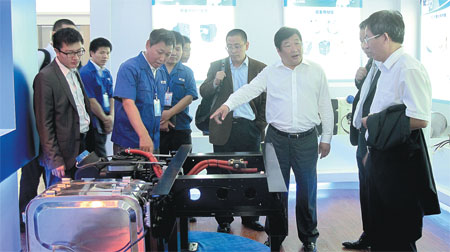
Kailong High Technology Company's product exhibation in Wuxi. |
Medium-scale companies form backbone of innovation
Business sensitivity, market foresight and a sense of crisis in the blood of Wuxi businessmen have made the pursuit of innovation a central task for them throughout history, said a local expert, and the slowdown of the Chinese economy requires them to re-awaken those traditional business genes as rapidly as possible.
"The macroeconomic situation in Wuxi is bad," said Shan Kangqi, vice-chairman of the Wuxi Federation of Industry and Commerce, starting his interview in an unusually candid way.
Unlike other Chinese cities, Wuxi does not rely on investment to boost economic growth. Private business accounts for nearly 80 percent of the city's economy, so difficulties for private enterprises become difficulties for the city.
"The rise of labor costs and the shrinking of overseas demand for labor-intensive products leave the private businessmen no choice but to use new technology or change to new products," Shan said.
"Medium-scale private enterprises with annual sales ranging from 500 million yuan ($80.6 million) to 1 billion yuan are the backbone of the city's economy," said Shan, the former head of a State-owned electrical fan factory in the 1980s. "They are more sensitive to market changes than SOEs."
Shan anchors his economic hopes on such private enterprises. Kailong High Technology Co, located in a suburb of Wuxi, is one of those. Now the largest manufacturer of after-treatment equipment for diesel emissions of heavy trucks and buses, Kailong benefits from company President Zang Zhicheng's sharp nose for the emissions-processing market in China.
Zang is an engineer who founded Kailong 10 years ago after quitting his job with a SOE in Wuxi. He is the patent holder of several key technologies in recycling emission heat from buses. When he saw that Cummins Engine Co from the United States priced its emissions after-treatment equipment almost as highly as its engines during a bid to clean up the emissions of 18,000 buses in Beijing in 2007, before the Olympic Games the following year, he decided to "end Cummins' monopoly".
The after-treatment equipment, which is affixed to the tailpipe, did not look hard to make, he said. It consists of a pump controlled by a processing unit connected with sensors of nitrogen oxide, a container of urea solution and a reaction kettle to mix emissions with the urea solution sprayed by the pump.
He invested all of his savings, about 100 million yuan, in the research in 2007. Within two years, his research and development team made breakthroughs in dozens of key technologies for the pump, processing unit and sensors.
Since late 2009, his company has manufactured after-treatment equipment, making all parts except for a sensor imported from a German company.
Annual sales from Kailong's after-treatment business will hit 1.6 billion yuan this year, Zang said, and are expected to reach 2.4 billion yuan next year.
Not far from Kailong is another model enterprise run by a young entrepreneur named Shen Qi, who is the president of Jiangsu Yoke Technology Co.
Shen is known for his huge appetite for new markets.
In his late 30s, Shen ran the largest fire retardant producer in the world, with an annual sales revenue of about $2 billion.
"I spent several years becoming the world's No 1 in that niche market. I believe someone will replace me in the same way. So I must look for new markets," Shen said. He saw a huge business opportunity in China's rising demand for natural gas. Within several years, through buying technology from abroad and intensive research and development in his company's labs, Jiangsu Yoke has already become one of the world's largest raw material providers for LNG transportation containers.
Yinhuan Holding Group Co Ltd is another example of Wuxi enterprises that seek new development in old industries. Radiation leakage at Fukushima Nuclear Power Station, caused by a massive earthquake in early 2011, changed the fate of the largest special steel pipe maker in Wuxi.
The factories had to suspend production. But Zhuang Jianxin, president of Yinhuan, did not stop looking for new business opportunities to "make up" his losses in the special steel pipe market.
When President Xi Jinping vowed last month to resume China's nuclear power projects, it injected new vigor into the businessman in his late 50s. His workshops will soon be running at full speed.


Copyright 1995 - . All rights reserved. The content (including but not limited to text, photo, multimedia information, etc) published in this site belongs to China Daily Information Co (CDIC). Without written authorization from CDIC, such content shall not be republished or used in any form. Note: Browsers with 1024*768 or higher resolution are suggested for this site.
License for publishing multimedia online 0108263 Registration Number: 130349