|
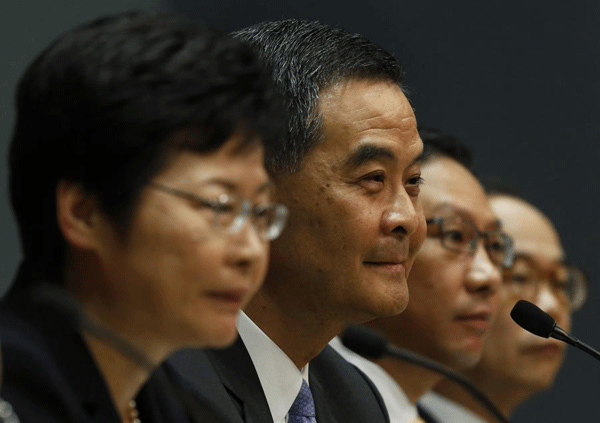 |
| (From L to R) Hong Kong Chief Secretary Carrie Lam, Chief Executive Leung Chun-ying, Secretary for Justice Rimsky Yuen and Under Secretary for Constitutional and Mainland Affairs Lau Kong-wah listen to a question during a news conference in Hong Kong July 15, 2014.[Photo/Agencies] |
|
Related Reading:
|
It involves national sovereignty, security and development, legislators said during the bi-monthly session of the Standing Committee of the National People's Congress, China's top legislature, currently underway in Beijing.
Committee members began examining a report from HKSAR Chief Executive Leung Chun-ying on Monday, discussing whether to revise election methods for the region's chief executive in 2017 and its Legislative Council in 2016.
They hailed Leung's report as positive, responsible and pragmatic as it summarizes thoroughly the opinions expressed by different sections of Hong Kong's communities during a public consultation by the HKSAR government from Dec. 4 last year to May 3.
The current chief executive was elected by a committee in 2012. Hong Kong plans to introduce universal suffrage, the right for citizens to vote, during the next election in 2017.
Basic Law requires candidates for the HKSAR Chief Executive be nominated by a "broadly representative" committee.
According to the report, disputes remain in Hong Kong on core questions including how the nomination committee will be formed and other procedures for deciding candidates.
Some proposals were obvious violations of Basic Law, lawmakers said.
The NPC Standing Committee should exercise power granted by the Constitution and the Basic Law of Hong Kong to make decisions on these core questions in order to promote consensus of the Hong Kong residents and ensure smooth implementation of the new electoral process in 2017.
The discussion was attended by Zhang Dejiang, chairman of the NPC Standing Committee.
On Tuesday's meeting, lawmakers also deliberated a bill to revise the country's Budget Law and suggested putting it to vote.
A majority of lawmakers said they were content with the current version of the bill, which was up for its fourth reading since December 2011.
The latest version responds to the most controversial issues for the country's budget management, including problems brought forth by the public.
The bill strengthened transparency, supervision and the ability to make and implement budgets. It will play an important role in promoting the country's reform, reviewers said.
One of the most controversial issues is local government bonds. The current law bans local governments from issuing bonds, but in practice local governments have sought backdoors to raise funds, mostly for infrastructure. The money has remained unsupervised.
To tackle this loophole, the bill gives the go ahead for bond sales by provincial-level governments but places them under strict conditions. It not only restricts the amount of bonds but also regulates how to issue and use the funds.
To improve transparency, the bill adds detailed provisions on publishing budget reports and improving supervision by lawmakers as well as the public.
It asks government finance departments to publish their budgets and final account reports within 20 days after they are adopted by the legislature. It also gives the public access to information about local government debts, purchases, budgets and audits.
The bill requires lawmakers to examine major expense items and big investments in budget reports as well as inspect the development and efficiency of such projects.


Copyright 1995 - . All rights reserved. The content (including but not limited to text, photo, multimedia information, etc) published in this site belongs to China Daily Information Co (CDIC). Without written authorization from CDIC, such content shall not be republished or used in any form. Note: Browsers with 1024*768 or higher resolution are suggested for this site.
License for publishing multimedia online 0108263 Registration Number: 130349