In 1980, then vice-premier Deng Xiaoping, highly praised Xiaogang's bold initiative, which was later applied to the whole country.

 |
|
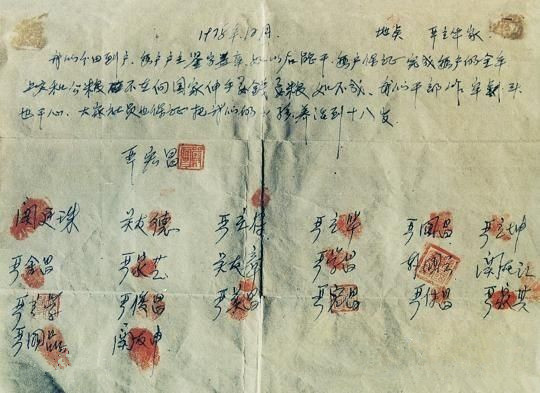
The contract Xiaogang villagers signed in 1978 agreeing to divide up collectively-owned land for private cultivation,a bold move seen as a capitalist action challenging socialist public ownership. The contract is on display at National Museum of China. [Photo from peopledaily.com.cn] |
When 18 destitute farmers put their thumb prints to a contract to divide up collectively-owned land for private cultivation 36 years ago, none expected a four-fold increase in grain output and that they could escape starvation in less than a year.
What they hadn't anticipated was their pilot scheme was agreed by China's top reformer Deng Xiaoping and later applied to the whole country, which substantially improved rural livelihoods.
On November 24, 1978, Yan Hongchang, a candidate for Xiaogang village chief in Chuzhou city, Anhui province, and representatives from 17 households signed a secret agreement to split land — an illegal act at a time China upheld collective ownership. They tried this risky approach in the hope that it would trigger a motivation for farming, thus ending begging and potential starvation.
The East China village, home to 118 people, thus became a pilot for what was later called a "household-based contract responsibility system" and applied across China since 1982. Under the system, land was leased to families.
Xiaogang's harvest of 1979 under the new system was stunning. The grain yield village-wide exceeded 70,000 kg, equaling 1955 to 1970's total; oilseed yield exceeded 17,500 kg, equaling that of the previous 20 years. Per capita income surged from 22 yuan($3.58)in 1978 to 400 yuan. Villagers for the first time had meat during major festivals and leftover food.
On May 31,1980, in an open talk Deng,then China's vice-premier, highly praised Xiaogang's bold initiative that liberated farmers, productive forces. In 1978 at a landmark Communist Party meeting, he had called for the Chinese people to free their minds and test legitimate and effective ways to create a better economy.
On Nov 1, 1982, the Chinese central government announced the application of the household-based contract responsibility system nationwide.
The responsibility system liberated productive forces, leading Chinese agricultural experts and economists, including Li Yining and Wu Jinglian, agreed, according to earlier reports.
Yan Junchang, a relative of Yan Hongchang and one who fought for the system at the time, told Xinhua News Agency in 2008: "The contribution of the system has been huge. Without it, farmers would not have solved the basic problems of food and clothing, and China would not have developed at such a speed".


Copyright 1995 - . All rights reserved. The content (including but not limited to text, photo, multimedia information, etc) published in this site belongs to China Daily Information Co (CDIC). Without written authorization from CDIC, such content shall not be republished or used in any form. Note: Browsers with 1024*768 or higher resolution are suggested for this site.
License for publishing multimedia online 0108263 Registration Number: 130349