|
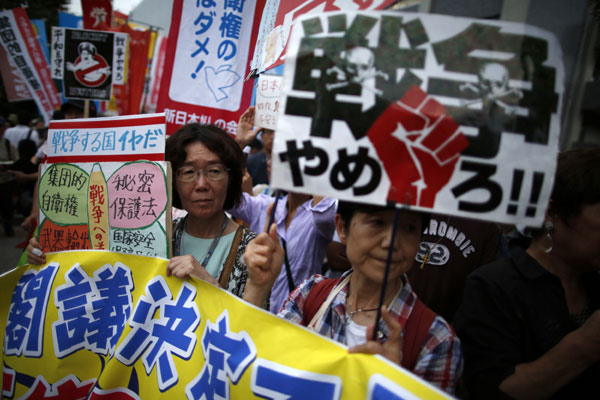 Protesters raise placards during a rally against Japan's Prime Minister Shinzo Abe's push to expand Japan's military role, in front of Abe's official residence in Tokyo on July 1. Abe's Cabinet adopted on Tuesday a resolution dropping a ban that has kept the military from fighting overseas since World War II. The placard (right) reads, "Stop War". Issei Kato / Reuters |
|
Key points of the paper External threats in Tokyo's eyes "The security environment surrounding Japan has become increasingly severe, being encompassed by various challenges and destabilizing factors, which are becoming more tangible and acute." "In FY2014, in light of the increasingly harsh security environment, defense-related expenditures were increased for the second consecutive year." "China is rapidly expanding and intensifying its activities in the maritime and aerial domains." In the Far East, "Russia continues active operations of its naval vessels and aircraft, conducting large-scale exercises in the region." Japanese operations overseas To prevent the emergence of threats to Japan, "the importance of the role played by defense capabilities is increasing in cooperative efforts as a member of the Asia-Pacific region and the international community." "The use of the minimum necessary force to defend Japan under the right of self-defense is not necessarily confined to the geographic boundaries of Japanese territory, territorial waters and airspace." "... it is difficult to give a general definition of the actual extent to which it (military force) may be used, as this would vary with the situation". Plans to increase defense capacity Japan's Defense Ministry is "currently in the middle of vigorously examining ways to build a Dynamic Joint Defense Force." The number of destroyers will be increased. Two Aegis-equipped destroyers be added. - China Daily |
The wording of the paper may also keep those eyebrows raised. In Chapter 1, Part 2, under the heading "Measures to Ensure Japan's Security," it says that "upon recognizing the role of defense capabilities, Japan aims to ensure national security as well as bring peace and safety to the Asia-Pacific region, and eventually to the entire world, through making its utmost efforts in a variety of fields".
Again, this might be the work of an overexcited bureaucrat, but it does seem at the very least presumptuous. To say that Japan is aiming to bring "peace and stability ... to the entire world" may indicate an ambitious mindset as yet unrevealed.
The wording gains in clarity, if not accuracy, in Section 2, sub-section 2 under the heading "The Government's View on Article 9 of the Constitution":
"The possession of armaments deemed to be offensive weapons designed to be used only for the mass destruction of another country, which would, by definition, exceed the minimum necessary level, is not permissible under any circumstances. For example, the Self-Defense Forces are not allowed to possess intercontinental ballistic missiles, long-range strategic bombers, or attack aircraft carriers."
Now, "attack" and "aircraft" could be a problem. Would a defense aircraft carrier possibly be permitted?
Last year, Japan launched the Izumo, a 250-meter-long "flat-topped destroyer". Named after a cruiser that was sunk by the United States in 1945, the warship is, in reality, an aircraft carrier. However, aircraft carriers imply a force projection well beyond Japan's shores, so therefore it must be called a destroyer or a helicopter carrier.
But the real concern is Section 2, under the heading "Constitution and the Basis of Defense Policy".
Sub-section 3 looks at the "geographic boundaries within which the right of self-defense may be exercised".
It states that "the use of the minimum necessary force to defend Japan under the right of self-defense is not necessarily confined to the geographic boundaries of Japanese territory, territorial waters and airspace. However, it is difficult to give a general definition of the actual extent to which it may be used, as this would vary with the situation".
However, Article 9 of the Japanese Constitution is written in clear language:
"Aspiring sincerely to an international peace based on justice and order, the Japanese people forever renounce war as a sovereign right of the nation and the threat or use of force as means of settling international disputes. ... (Therefore) land, sea, and air forces, as well as other war potential, will never be maintained."
The contrast between those precise words and "difficult to give a general definition" is what should cause concern.
cliffordtomsan@hotmail.com


Copyright 1995 - . All rights reserved. The content (including but not limited to text, photo, multimedia information, etc) published in this site belongs to China Daily Information Co (CDIC). Without written authorization from CDIC, such content shall not be republished or used in any form. Note: Browsers with 1024*768 or higher resolution are suggested for this site.
License for publishing multimedia online 0108263 Registration Number: 130349