China's air quality improved slightly in the first half of 2014 compared with the same period in 2013, but aggravated ozone pollution became a prominent problem across the country, according to Environmental Protection Ministry figures released on Monday.
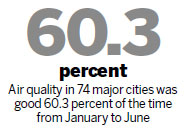
In 74 major cities, air quality was good 60.3 percent of the time from January to June. The figure was 58.7 percent during that period in 2013. In addition, the frequency, duration and pollution concentration of severely polluted days all decreased this year.
A ministry official who wished to remain anonymous said the improvement came from tougher policies adopted after the Airborne Pollution Prevention and Control Action Plan was issued in September 2013, and more favorable weather conditions.
But the rising ozone level marred the overall improvement. Ozone concentration increased by 6.8 percent nationwide - it was as high as 12.8 percent in the Yangtze River Delta region.
Although ozone is beneficial in the stratosphere, blocking ultraviolet rays from reaching Earth, high ozone levels at low altitudes can irritate the eyes and irreversibly damage the lungs and central nervous system. Adding to the danger, ozone pollution is easily shrugged off by the public because it does not affect visibility, said Chai Fahe, vice-president of the Chinese Research Academy of Environmental Sciences.
Chai said ozone levels can be raised by natural conditions such as stronger sunshine and higher temperatures, and by manmade factors such as growing concentrations of nitrogen oxide and volatile organic compounds.
"The total of nitrogen oxide emissions has just reached the peak, but VOCs are still increasing because they are just beginning to be controlled," he said.
The higher average temperature in the first half of 2014, compared with last year, is also likely a factor, he said.
Regionally, air quality improved in the Beijing-Tianjin-Hebei cluster, by 3.2 percent, in 2014. But it decreased by 0.5 percent in the Yangtze River Delta region, and by 0.8 percent in the Pearl River Delta.
"The results reflected the level of efforts made by the government bodies of the three regions," said Chai. "Policies being adopted in the Beijing-Tianjin-Hebei cluster are unparalleled in the nation."
But despite these efforts, eight of the 10 cities with the worst air quality in the first half of 2014 are in that region. The 10 cities were Xingtai, Shijiazhuang, Baoding, Tangshan, Handan, Hengshui and Langfang, all in Hebei province; Jinan in Shandong province; Xi'an in Shaanxi province and Tianjin.
wuwencong@chinadaily.com.cn
(China Daily 07/22/2014 page5)


Copyright 1995 - . All rights reserved. The content (including but not limited to text, photo, multimedia information, etc) published in this site belongs to China Daily Information Co (CDIC). Without written authorization from CDIC, such content shall not be republished or used in any form. Note: Browsers with 1024*768 or higher resolution are suggested for this site.
License for publishing multimedia online 0108263 Registration Number: 130349