 |
|
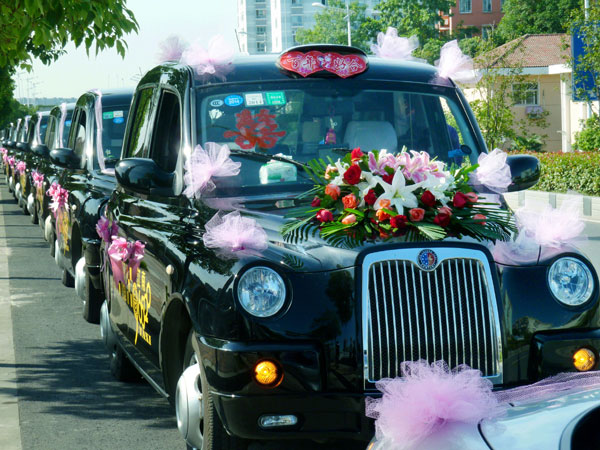
A wedding motorcade of classic British TX4 taxis drives along the street in Jiangsu province's capital Nanjing. Chinese weddings are often used to show off wealth. Wang Luxian / For China Daily |
Opulent dowries are new conventions, rather than traditions, in such places as Fujian province's Jinjiang city, as local entrepreneurs get rich. But that forces others to struggle to 'keep up with the Joneses'. Sun Li and Hu Meidong explore matrimony's monetary starting points in the city.
After attending a wedding banquet last month in Fu-jian province's Jin
jiang city, Yan Hongming joked that he'd changed his 2014 resolution from getting six-pack abs to marrying a woman from Jinjiang.
"It wasn't local women's charm that made me say that," he explains."I don't intend to really marry a Jin-jiang lady. I just couldn't find a better way to express myself about the wedding's impact on me."
Yan says the motorcade consisted of fancy sporty cars, such as Ferraris and Bentleys.
The motorcade's first automobile, a Porsche Cayenne decorated with flowers and a red ribbon, was a gift from the bride's father, a Jinjiang food company entrepreneur.
The groom's father is a Jinjiang real estate businessman.
Guests sat around about 50 tables. Each table cost more than 10,000 yuan ($1,601).
During the banquet, the host read to the attendees the litany of valuable dowries that included bank accounts and real estate.
Yan, a 26-year-old from Fujian's Longyan city, said he knew rich men's daughters in Jinjiang are married off with bountiful dowries. Yet he was still amazed by the extravagance.
What Yan saw was certainly not the biggest wedding dowry in Jinjiang's history.
In December 2012, Wu Duanbiao, chairman of the ceramics firm Fujian Wanli Group, gave his daughter a lavish dowry that included four boxes of gold jewelry, shares in the ceramics firm, a villa, two luxury cars and tens of millions yuan in cash. The dowry was worth about 1 billion yuan.
In November that year, Jinjiang native Wu Jinbiao, chairman of Billion Industrial Holdings Ltd, spent more than 250 million yuan to marry off his daughter.
The region's generous dowries continuously make headlines.
In April, photos of brides from Jinjiang's administrative city Quanzhou, who wore what's said to be half a kilogram of gold jewelry, went viral. Thousands of netizens were stunned by these "golden brides" and quipped that marrying a local girl is "better than robbing a bank".
Local folk custom expert Fu Sunyi says gold wedding jewelry and big dowries are commonplace in the area.
"But the amount of gold and dowry sizes depend on families' financial situations," Fu says.
"There is no city history to which extravagant dowries or 'golden brides' can be traced. It would be a misinterpretation if people regard the practice of bestowing generous dowries as a traditional marital custom of Quanzhou and Jinjiang."
Xu Wendian, a 70-year-old Jinjiang resident, says the expensive dowries first appeared in the 21st century.
In the 1950s, local weddings featured musicians and a sedan chair for the bride. In the '60s, the dowry only included daily necessities, such as a thermos and towels, Xu recalls.
In the '70s, bicycles and sewing machines had become popular. A decade later, televisions and motorbikes were in vogue. As the regional economy boomed in the 1990s, cars and apartments made the list.
The bar has since risen.
Fu Sunyi says bestowing generous dowries lets daughters inherit families' wealth.
Jinjiang is celebrated for producing slews of successful entrepreneurs.
"Since the preference for male over female babies is deeply rooted in southern Fujian province, daughters are regarded as 'spilled water' that cannot be taken back. Many families still believe only the son has the right to inherit the families' fortunes," Fu says.
"So the dowry is a form of distribution of family fortunes because parents won't let daughters have a dime."
The folk customs expert explains the dowry is intended to assure economic equality between husbands and wives, and to ensure brides are treated well by husbands and in-laws.
Fuzhou University sociologist Gan Mantang says a "keeping up with the Joneses" psyche has contributed to the phenomenon.
Dowries' size suggests how wealthy a family is. So opulent offerings earn families face, Gan says.
"Some don't want to be left behind when others boast extravagant dowries so they also try to provide them," he says.
Ding Yafang, from Jinjiang's private shoes and sportswear enterprise hub Chendai town, says such dowries are extreme burdens for some families.
Unlike much of the rest of the country, the custom in Quanzhou and particularly in Jinjiang doesn't call for guests to provide red envelopes packed with cash to cover costs. So the brides' families don't get any compensation.
"Some friends' families had to borrow quite a bit of cash to put up a show to save face," Ding says.
Gan says people shouldn't get caught up in the hype.
They should control budgets according to their financial realities.
"After all, we don't marry for money," he says.
"Happiness isn't about how much gold you have."
Contact the writers through sunli@chinadaily.com.cn


Copyright 1995 - . All rights reserved. The content (including but not limited to text, photo, multimedia information, etc) published in this site belongs to China Daily Information Co (CDIC). Without written authorization from CDIC, such content shall not be republished or used in any form. Note: Browsers with 1024*768 or higher resolution are suggested for this site.
License for publishing multimedia online 0108263 Registration Number: 130349