Premier says WHO, World Bank and China can jointly push reforms
To provide better healthcare services, the Chinese government will increase its input and encourage social capital to enter the industry, Premier Li Keqiang said on Tuesday.
These moves would help to minimize patients' out-of-pocket expenses, effectively prevent and cure diseases, and create more quality healthcare resources, Li said.
The biggest change in China's industrial restructuring is to develop its service industry, and the healthcare sector could take the leading role to benefit all citizens and boost growth, he said.
Li made the remarks during a meeting with Jim Yong Kim, president of the World Bank, and Margaret Chan, director-general of the World Health Organization.
It is a "creative step" for China, the World Bank and the WHO to jointly push forward China's healthcare reforms, the premier said.
Kim told Li he was on a "rare joint visit" to China with Chan because they "admire so much what you have done in the first phase of healthcare reform".
In 2009, China announced that more than 850 billion yuan ($137 billion) would be spent by 2011 to provide universal medical services to the country's 1.3 billion residents. The actual expenditures was bigger than that.
Such efforts have made medical services more affordable and accessible, and narrowed a wide gap between urban and rural healthcare. However, problems such as a scarcity of doctors and violent attacks by patients on medical staff are still hindering reforms.
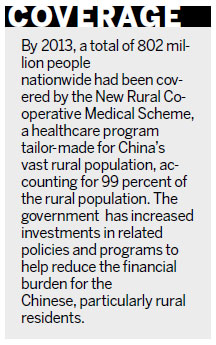
China's latest round of healthcare reform, still underway, began in 2003 with the launch of the New Rural Cooperative Medical Scheme, a healthcare program tailor-made for China's vast rural population.
By 2013, a total of 802 million people nationwide had been covered by the first ever health insurance program in China, accounting for 99 percent of the rural population.
The government has increased investments in related policies and programs to help reduce the financial burden for the Chinese, particularly rural residents.
Both Kim and Chan voiced support and optimism for this undertaking in China, saying the country's experiences in taking care of its people could be a lesson for others and be turned into the next industry for future growth.
"China is unique because of your outstanding personnel, finance and other things, and also your ability to get things done," said Kim, highlighting his confidence that China could build the best healthcare system in the world. China has the ability to become the world's biggest producer of medicines and diagnosis, said Chan.
"It is no doubt that you are going into the deep-water zone, which is hospital reform. But this is not the time to stop," she added.
Hu Shanlian, a professor of public health at Fudan University in Shanghai, said more money should be allocated to hospitals at grassroots levels.
Large public hospitals must spend money more wisely as they can no longer rely heavily on drug sales, which contributed to inflated drug prices and tension between patients and doctors, he said. There is also great potential for the development of private hospitals, backed by social capital, but other supplementary mechanisms such as commercial insurance must be improved, Hu added.
Contact the writers at zhaoshengnan@chinadaily.com.cn and shanjuan@chinadaily.com.cn


Copyright 1995 - . All rights reserved. The content (including but not limited to text, photo, multimedia information, etc) published in this site belongs to China Daily Information Co (CDIC). Without written authorization from CDIC, such content shall not be republished or used in any form. Note: Browsers with 1024*768 or higher resolution are suggested for this site.
License for publishing multimedia online 0108263 Registration Number: 130349