Editor's note: Xinjiang is known for its colorful landscape and diverse culture. China Daily explores this beautiful region through its many faces and facets.
|
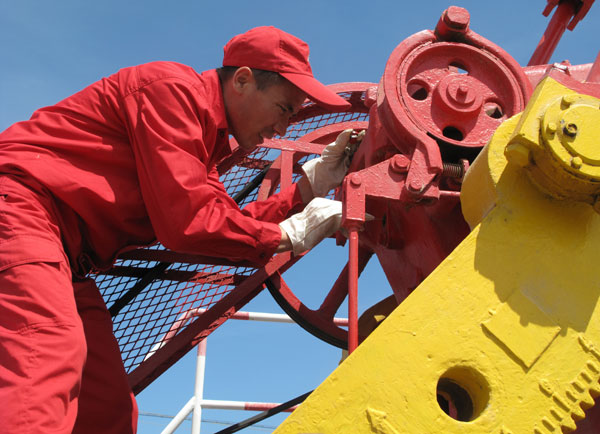 |
| Rozememet Bak works at his post at an oil field in Karamay, the Xinjiang Uygur autonomous region.[Yang Wanli/China Daily] |
Speaking Mandarin for the first time was an unforgettable experience for Rozememet Bak, a member of the Uygur ethnic group.
Rozememet, 38, was born in a small town in the southern part of the Xinjiang Uygur autonomous region. He traveled to Karamay in 1991, seeking a career that would be different from his elders.
Karamay, a city famous for its fossil fuels, attracts migrants - especially those of the younger generation - with its living conditions and job opportunities.
After studying for four years at Karamay Fossil Oil Vocational School, Rozememet landed a job with Xinjiang Oil Field Co.
"I stood at the employees' registration counter and told them I was the 'one child' in my family," said Rozememet, who has four younger brothers.
"All the people nearby burst into laughter, and one of them corrected my mistake, telling me I should say 'the first' or 'eldest' child."
Rozememet grew up in Hotan and lived in an area where most residents are Uygur and where most work in the fields.
Writing in Chinese was even harder for him. Each of the characters was like a uniquely small, artistic picture that was hard to decipher.
"It was too difficult to remember them. I felt so frustrated," he said.
Unlike southern Xinjiang, where few residents can speak Mandarin, most people in Karamay are members of the Han ethnic group, descendants of early settlers.
But Rozememet soldiered on. A Uygur idiom from his father, a primary school teacher in Hotan, has been his driving force.
"Only when the grass grows vigorously can the pasture could be good enough for grazing," Rozememet said.
"If I don't strive to overcome the language barrier, the door to a better future will be closed forever."
At the oil company, about 30 percent of the employees are members of ethnic minorities - Uygur, Kazak, Hui and Mongolian. To help them overcome language difficulties, the company arranged for Han workers to teach them.
With the help of his Han colleagues, Rozememet gradually learned.
In the following 11 years, he also earned a bachelor's degree and two professional training degrees at a Chinese college. He now speaks Mandarin fluently.
To help more ethnic minority employees learn the language, Rozememet wrote three bilingual guidebooks to explain operational details of the company and one small dictionary introducing technical terms in Uygur. The materials he wrote and compiled are used to train new employees.
Rozememet's courage and efforts have also inspired his brothers. One of them is a teacher at a local high school, two are working outside the country, in Australia and Saudi Arabia, and his youngest brother is studying at the Beijing Technology and Business University. U
His father also engraved "Rozememet Bak" on the roof beam of their new home in Hotan as a mark of pride.
In 2007, Rozememet was invited by Karamay No 3 High School, where more than 70 percent of the students come from rural areas, to give lectures to encourage more students from ethnic minorities to learn Mandarin.
"I feel a strong desire to let them know about the great opportunities in the world that they will have."
Mao Weihua contributed to this story.
yangwangli@chinadaily.com.cn


Copyright 1995 - . All rights reserved. The content (including but not limited to text, photo, multimedia information, etc) published in this site belongs to China Daily Information Co (CDIC). Without written authorization from CDIC, such content shall not be republished or used in any form. Note: Browsers with 1024*768 or higher resolution are suggested for this site.
License for publishing multimedia online 0108263 Registration Number: 130349