President re-affirms vow at meeting with leaders of Peaceful Coexistence doctrine's founding countries
 |
|
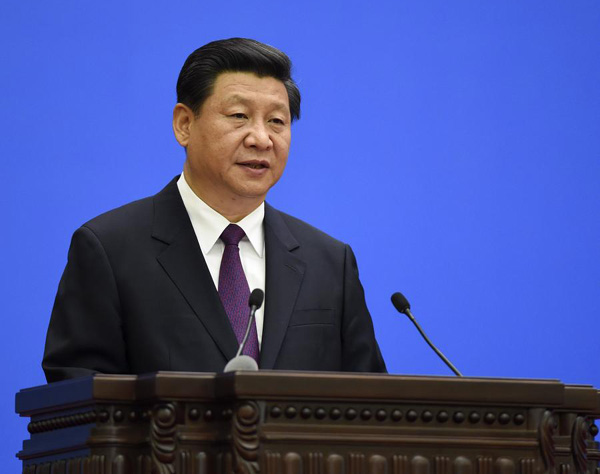
Chinese President Xi Jinping on Saturday delivered a keynote speech at a commemoration marking the 60th anniversary of the Five Principles of Peaceful Coexistence at the Great Hall of the People in Beijing.[Photo/Xinhua] |
China will never seek hegemony, no matter how strong it becomes, President Xi Jinping said on Saturday at a high-profile meeting to mark the 60th anniversary of the Five Principles of Peaceful Coexistence.
"China does not accept the logic that a strong country is bound to become hegemonic, and neither hegemony nor militarism is in the Chinese DNA," Xi said in a speech, as he played host to leaders from Myanmar and India to commemorate the anniversary.
Citing poems and old sayings from the three countries, Xi called for dialogue based on equality to resolve disputes and joint efforts to preserve regional peace.
He also announced the establishment of a friendship award and an outstanding scholarship related to the Five Principles of Peaceful Coexistence.
|
 |
| Myanmar leader hails ties |
Observers said Xi's remarks and the first meeting of leaders of all three of the peace code's founding countries since its inception sought to assure the world of China's peaceful development amid simmering tension in the East and South China seas.
It will take time for China, or any growing power, to be fully accepted by the world. But China will prove its intentions with its actions, based on the five principles, which can play a bigger role in the current international community, they added.
In 1954, the leaders of China, India and Myanmar initiated the Five Principles of Peaceful Coexistence. They are mutual respect for sovereignty and territorial integrity; mutual non-aggression; non-interference in each other's internal affairs; equality and mutual benefit; and peaceful coexistence.
The joint commemoration - especially the presence of Myanmar's President U Thein Sein and India's Vice-President Mohammad Hamid Ansari - shows those two countries' efforts to push forward the peace code and their relationship with China, said Zhang Jiuhuan, former director of the Department of Asian Affairs at the Foreign Ministry.
Having guided the rapid development of ties between China and Southeast Asia, the principles could also lead to the resolution of issues between China and some Southeast Asian countries in the South China Sea, said Zhang, who is also a former Chinese ambassador to Singapore and Thailand.
Wang Fan, vice-president of China Foreign Affairs University, said the five principles could be developed to become a mechanism to guarantee the spirit's future implementation.
East Asia - divided by an outdated alliance system - lacks a sound multilateral platform for cooperation. So the five principles under a mechanism could better restrict all concerned parties, he said.
Ansari also called for "a new paradigm for global action", "a framework in which opportunities and challenges for the betterment of our societies coexist".
The five principles "can act as a catalyst", he said in a speech at the meeting.
zhaoshengnan@chinadaily.com.cn


Copyright 1995 - . All rights reserved. The content (including but not limited to text, photo, multimedia information, etc) published in this site belongs to China Daily Information Co (CDIC). Without written authorization from CDIC, such content shall not be republished or used in any form. Note: Browsers with 1024*768 or higher resolution are suggested for this site.
License for publishing multimedia online 0108263 Registration Number: 130349