 |
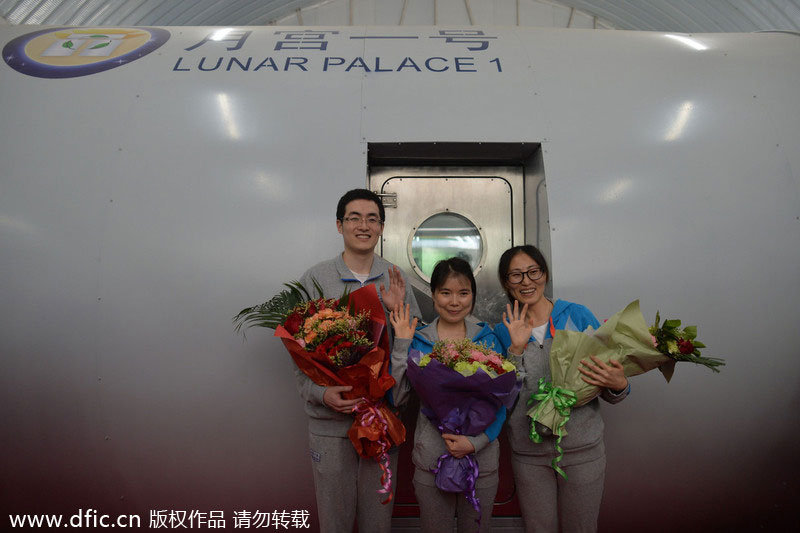
| Dong Chen, left, Xie Beizhen and Wang Minjuan have emerged after 105 days of scientific experiments in Lunar Palace 1, the Integrative Experimental Facility for Permanent Astrobase Life-support Artificial Closed Ecosystem (PALACE) Research, developed by Beihang University in Beijing on May 20. It was the first long-term multi-crew sealed cabin research carried out in China. [Photo/IC] |
BEIJING - China is a step closer to setting up a lunar base after a 105-day manned airtight test, in which the bio-regenerative life support systems of Lunar Palace 1 sustained the lives of three trial volunteers.
The three "moon dwellers" drank recycled purified water, ate worms and food they grew themselves, conducted experiments, and chatted with their family on the Internet in the enclosed capsule from February 3 to May 20.
The full title of the project is Integrative Experimental Facility "Lunar Palace 1" for Permanent Astrobase Life-support Artificial Closed Ecosystem Research, in short, Lunar Palace 1, a royal residence for the moon.
Lunar Palace 1 comprised a 58-square-meter vegetation cabin and a 42-square-meter living cabin with three bedrooms, a dining room, a bathroom, and a waste disposal room.
Scientists selected food that could provide enough nutrition for the three post-1980s volunteers: five cereals, including wheat, soybeans and peanuts; 15 vegetables, including carrots, cucumbers, and water spinach; and the only fruit, strawberries.
Wheat is not only the main energy source, but also the oxygen provider in the capsule which enabled the oxygen to be regenerated three times during the 105 days.
Fifty-five percent of the food for the three volunteers was generated inside the bio-system, while the rest, mostly meat, was externally produced.
But the capsule inhabitants also raised and ate yellow mealworms, their main source of protein.
The debut of these worms at the IAA Humans in Space Symposium in 2011 shocked peers from the U.S., but some said they tasted like French fries after they tried them.
Lunar Palace 1 is different from Biosphere 2, an Earth systems science research facility in the U.S., says chief designer and lead scientist Liu Hong, a professor with the Beihang University.
"Biosphere 2 is a duplication of the living environment on Earth, which is a failure we did not want to repeat," says Liu.
"The system we made was directed towards the needs of humans. We carefully chose what plants, animals, and micro-organisms would be best included in the ecosystem."
Although the U.S., Russia, and some European countries have been working on specific related technologies, they've conducted no large-scale system experiments in recent years.
"Many foreign experts think building a space base cannot be achieved in the near future, so they do not put many resources into research in this field," says Liu.
But the length of time needed to understand the complexity of an eco-system is why scientists should start experimenting now.
Lunar Palace 1 does not perfectly mirror the environment on the moon.
The low gravity and high radiation are not factored into the capsule; and scientists do not know how these would affect the ecosystem.
Liu says it is necessary to build two mini Lunar Palace 1 systems - a monitoring station on the moon and one on earth - so the two sets of data can be compared
The experiment results were better than expected, but there is still room for improvement.
"The system is only mature when it can be run for a long time, " she says. "Then we can be confident of using it in outer space."
 |
 |
 |
|
Company Special: ChemChina companies give boost to lunar mission |
Copyright 1995 - . All rights reserved. The content (including but not limited to text, photo, multimedia information, etc) published in this site belongs to China Daily Information Co (CDIC). Without written authorization from CDIC, such content shall not be republished or used in any form. Note: Browsers with 1024*768 or higher resolution are suggested for this site.
License for publishing multimedia online 0108263 Registration Number: 20100000002731 

