|
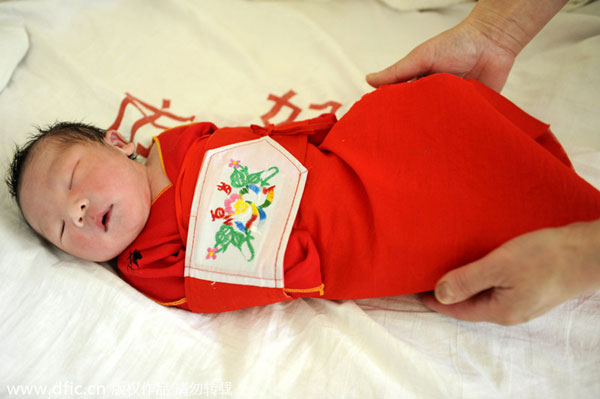 |
| A newborn baby dressed by his parents at a hospital in Shenyang, Northeast China's Liaoning province on March 20. Chinese parents often seem to be looking to major events for inspiration for the names of their babies. [Photo/IC] |
Historical books may offer details concerning the different stages since the founding of the People's Republic of China in 1949 – but you can also learn something from Chinese names.
Chinese parents often seem to be looking to major events – or historical milestones - for inspiration for the names of their babies – such as Jian'guo, which refers to the establishment of the People's Republic, and more recent popular names such as Hexie ("harmonious society") and Aoyun ("Olympics").
More than 960,000 Chinese share the name Jian'guo, including about 24% who were born between 1949 and 1959, according to data from the National Citizen Identity Information Center (NCIIC). This name was rarely given to newborns before 1949.
From 1950 to 1960 there was a surge in Chinese names representing the new China and people's hopes for a prosperous country, including names such as Jianhua (which has a similar meaning to Jianguo) and Guoqiang ("strong country").
In addition, about 60% of Chinese with the name Minzhu ("democracy") were born in the 1950s.
During the Korean War (1950-1953), Chinese people often chose names to reflect the conflict, as tens of thousands of babies were named Yuanchao ("aid the Korean people"), Kangmei ("resist US aggression") and Weiguo ("guard China's territory against infringement").
A total of 493 Chinese people sharing the family name Zhang were given the name Yuanchao – and nearly 90% were born in the 1950s. Zhu De, the former commander in chief of the Chinese People's Liberation Army, also chose "Yuanchao" for his eldest grandson.
In the period of "cultural revolution" (1966-76), Chinese parents showed their loyalty to the "revolution" by giving names such as Weihong (which literally means "protect red" – meaning the revolution), Weidong (literally meaning "protect Dong" which refers to Chairman Mao Zedong) and Xuenong ("learn from the peasants"). Some new babies were also named Wenge, which means "cultural revolution."
The pool of Chinese names became more varied from 1978, when China initiated its policy of reform and opening-up. And, since the start of the one-child policy in the 1980s, parents also sometimes abandoned the traditional naming pattern of two or three characters in one name – and instead used four characters.
This reflects the parents' aim to have a name for their only child which contained the family name of both the father and mother – rather than only the father's family name.
A new naming trend began in 2001 following China's successful bid to host the Olympics in 2008, with about 31,000 infants named Shen'ao ("bid for the Olympics") or Aoyun ("Olympics").
In 2008, a total of 4783 babies were named Aoyun.
But the popularity of children's names connected with national events means that many people in China share the same names – especially as many Chinese people also share a small number of family names.
In an attempt to help their child stand out?from the crowd, one Chinese couple even tried to name their baby "@" saying the symbol sounds like "love him" in Mandarin.


Copyright 1995 - . All rights reserved. The content (including but not limited to text, photo, multimedia information, etc) published in this site belongs to China Daily Information Co (CDIC). Without written authorization from CDIC, such content shall not be republished or used in any form. Note: Browsers with 1024*768 or higher resolution are suggested for this site.
License for publishing multimedia online 0108263 Registration Number: 130349