 |
|
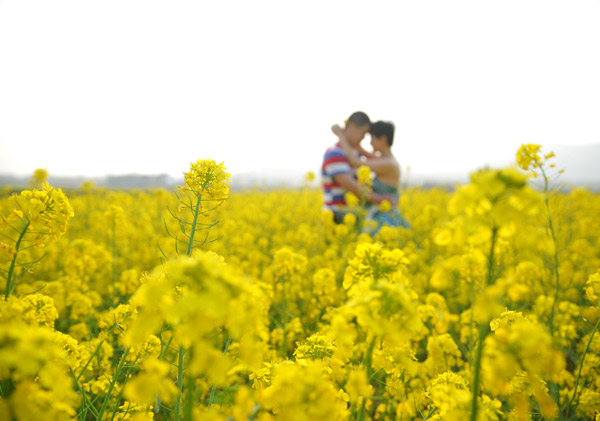
A couple enjoys the spring in a rape flower field in Zaozhuang city of Shangdong province. More and more young, educated and high-income Chinese couples are choosing not to have children. |
While the family has long remained Chinese society's fundamental building block, couples who opt against parenthood are finding growing acceptance as the country's economic transformation reconstructs society.
While some "double-income-no-kids", or DINK couples, cite freedom from the burden of parenthood, others name motivations such as social concerns, pollution, education costs and food safety.
"Would the child I could bring into this world choose to be born if it could?" asks a 38-year-old man.
The man, Liu Dong, who refuses to provide his real name for privacy reasons, points out children who aren't yet conceived can't express their wishes.
"That's one of the main reasons I don't want kids. I don't want my kid to live a bitter life. But life is bitter."
He and his wife are going against the mainstream belief that the starting point for a happily married life is children. They instead subscribe to the "world of two" philosophy.
In fact, there is a growing number of fertile couples, in which both partners work, who elect not to have children. The term DINK originated in the West in the 1960s. The notion arrived in China in the 1980s, after the opening-up and reform.
Reports show many Chinese DINK couples are young, educated and high-income.
Liu and his wife run a small gift shop in a Beijing hutong. They enjoy carefree lives and travel to Southeast Asia every year to explore the stunning landscapes and exotic cultures.
They don't face much pressure, especially since their parents agree with their DINK lifestyles.
Chinese parents conventionally push their children to marry and have children - to the point some people wed and start families against their personal wishes.
"We're not confident we can provide the best for a baby," Liu says.
"It's not just about money. It's about society. Social conditions matter most, since humans are social animals."
His mother is a retired middle school teacher who conducts after-class programs in Beijing.
She jokes that if Liu and his wife have a child, they shouldn't send the kid to school because the students face too much pressure.
"They're forced to learn a lot of useless information," Liu says.
"They don't finish as the same innocent children they start as. The education process strips away their good qualities."
Liu says he and his wife have watched the kids of his relatives, neighbors and friends grow up glumly because of traditional education and patriarchal family structures.
"Chinese families don't allow much freedom," Liu's wife says. "Elders may believe they have the right to interfere in your life and family. But everyone should be independent."
Liu points out many parents don't have lives outside their children. They give their offspring love and devotion - but perhaps to the point of smothering.
He sometimes wonders what his child would be like if he had one. He has a friend who is a freethinking and educated woman in her 20s.
"I'd hope my kid could be like her," Liu says. "She feels the pain of life but isn't defeated by it. Yet I'm not confident my kid would be like her."
|
 |
 |


Copyright 1995 - . All rights reserved. The content (including but not limited to text, photo, multimedia information, etc) published in this site belongs to China Daily Information Co (CDIC). Without written authorization from CDIC, such content shall not be republished or used in any form. Note: Browsers with 1024*768 or higher resolution are suggested for this site.
License for publishing multimedia online 0108263 Registration Number: 130349