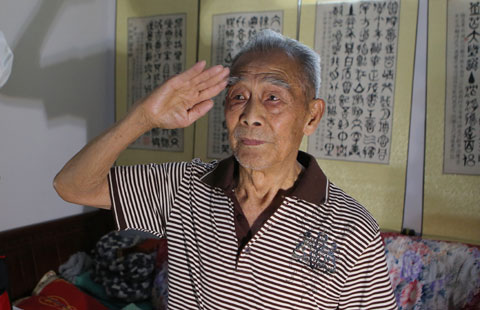
"Whatever difficulties ahead, I must get a Beijing hukou," said Wang Haijun, a non-Beijinger who resigned his high salary job in Beijing to pursue a Phd to have a chance to get a hukou here.
The lack of hukou, or a household registration for permanent residence in big cities like Beijing, restricts a local citizen's rights in house or car purchase, children's education and so on.
Wang didn't care much about establishing a Beijing hukou when looking for a job after receiving a master's degree in a university in Beijing in 2007.
But things became harder after he got married in 2011. It took at least four days to get a birth permit, a must-have certificate before couples could have a baby in China. Because they didn't have the Beijing hukou, the couple had to go back to their hometown to register. Beijing citizens can do it in a day.
Wang is not alone. So far, Beijing has a permanent resident population of 21.14 million, in which 8.02 million are without Beijing hukou. Shanghai has 24.15 million residents, with 9.9 million without a hukou and Guangzhou 12.83 residents, with 4 million without a hukou.
The National Urbanization Plan 2014-2020 issued recently calls for government to "strictly control megalopolis' population". What that means for people like Wang Haijun in Beijing, and others in Shanghai and Guangzhou is that it will be even harder to get a hukou or a local household registration and enjoy citizen rights in those cities.
The hope for registration reform seems unlikely. Some people choose to stay, like Wang Haijun. "I have no choice but to quit my job now. Only by further study can I have a chance to be a fresh graduate and get the Beijing hukou," Wang said. It is easier for a fresh graduate to get a Beijing hukou.
Some people leave. Cao Zhiqiang, who was born in Hunan and worked in Guangzhou for over 10 years, recently sold his house in Guangzhou suburbs and moved to Huizhou, another city easier to get a hukou. "I've been used to big city life but I didn't want my child to be a second-tier citizen and continue to float in Guangzhou." Cao said.
People are faced with such hard choice and cities are trying to figure out a transitional way. Shanghai and Guangzhou are advocating a residential permit system for people working there to enjoy the same rights as the local residents. Beijing is expected to carry out this plan this year.
But it still has many restrictions. Zhang Qiwei, working in Shanghai from 2007, had trouble without a Shanghai hukou. To get a permit to Taiwan, he travelled to Shenzhen, where his hukou is, twice. His child had to register at his hukou in Shenzhen and had trouble going to school in Shanghai.
It's recently been announced that Beijing will transfer some of its administrative functions to Baoding in nearby Hebei Province. It seems people like Wang Haijun in Beijing may have more chances of moving to Baoding and keeping Beijing residents' rights.
"The chance is slim and it will take many years. My child can't wait. I can pursue the hukou only if I have a doctoral degree," Wang said.
Duan Chengrong, a professor of society and demography at Renmin University of China, said, "it's very hard to control population only by curbing hukou in big cities. The key is to eliminate the development of a gap of different areas." Beijing, Shanghai and Guangzhou hukou means more privileges, so analysts think sharing citizen rights and providing more public service to more people is the right way to solve this dilemma.


Copyright 1995 - . All rights reserved. The content (including but not limited to text, photo, multimedia information, etc) published in this site belongs to China Daily Information Co (CDIC). Without written authorization from CDIC, such content shall not be republished or used in any form. Note: Browsers with 1024*768 or higher resolution are suggested for this site.
License for publishing multimedia online 0108263 Registration Number: 130349