 |
|
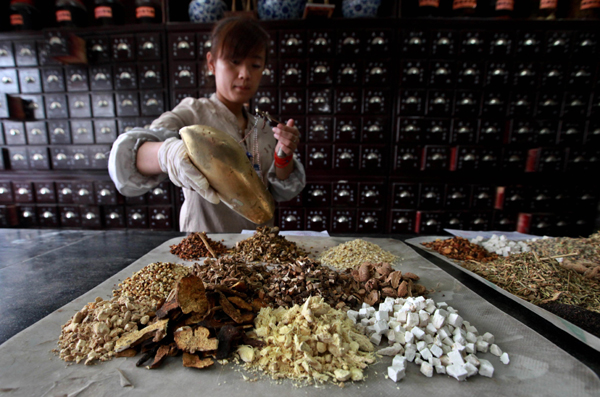
The safety of Chinese medicinal herbs is now a big concern of the country's health authorities. Dang Yun / for China Daily |
Amid concerns over soil pollution and use of pesticide, the government should strengthen oversight of ingredients in traditional Chinese medicine, industry insiders suggested
"Some medicinal herb farmers are intentionally using highly toxic chemicals such as pesticides in the hope of increasing output, resulting in an excessive residue in products," Xu Shuqing, a deputy to the National People's Congress, told China Daily.
Xu, who is also chairman of private pharmaceutical company Guangxi Wuzhou Zhongheng Group in the Guangxi Zhuang autonomous region, added that deteriorating farmland and water polluted by heavy metals are also concerns.
Enterprises that produce traditional Chinese medicine have been involved in disputes with health authorities in Western countries over whether their products are safe for consumers.
Many Chinese companies have failed to pass stringent tests required by Western regulators.
Health concerns have intensified since last June when Greenpeace issued a report saying that more than 70 percent of 65 medical herbs sold in nine well-known pharmacies on the Chinese mainland, including Beijing's Tongrentang, were found to contain pesticides.
Greenpeace said it ran tests between July 2012 and April 2013 on several herbs that are commonly used in traditional Chinese medicine and found that 48 out of 65 samples contained pesticides.
A total of 32 samples had residues of at least three kinds of pesticide. Traces of six pesticides banned by Chinese authorities in herbs, such as carbofuran and phorate, were found in 26 samples.
"The government should demand that local authorities strictly implement guidelines on medical herb cultivation while making national plans for the development of the herb-farming industry," Xu said.
"The training for professionals involved in medicinal herbs and publicity about agricultural chemicals should be stepped up."
China consumed more than 1.2 million metric tons of medicinal herbs in 2012, according to Xu.
Compared with food safety, a national priority, the supervision and regulation of medicinal safety are far from adequate, said Tang Nong, another NPC deputy and president of the Guangxi University of Chinese Medicine.
"We can't afford to stain the reputation of our traditional medicine, which has been accumulated over millennia, because of unscrupulous practices and lax regulation," he said.
"In addition to planting, the government should also better supervise the processing since unchecked processing also pollutes the medicine and compromises the efficacy."
Some pharmaceutical companies use sulfur to treat herbs to prolong their longevity, Tang noted, adding that such practices pose grave threat to consumers.
Guangxi has 4,632 medicinal herbs, ranking second in China next to Sichuan province, he said.
"We have discussed the safety and quality issues with our Western counterparts, but the platform for such exchanges needs to be expanded," the professor said, suggesting that communications should be stepped up to facilitate international cooperation.
zhaolei@chinadaily.com.cn


Copyright 1995 - . All rights reserved. The content (including but not limited to text, photo, multimedia information, etc) published in this site belongs to China Daily Information Co (CDIC). Without written authorization from CDIC, such content shall not be republished or used in any form. Note: Browsers with 1024*768 or higher resolution are suggested for this site.
License for publishing multimedia online 0108263 Registration Number: 130349