Overseas cyberattacks remain a major problem in China, the nation's Internet security watchdog said on Friday, and special government departments and laws must be established to tackle the increasingly serious online attacks and boost international cooperation against hacking.
Last year, 11.35 million computers in China were hacked into, a 22.5-percent drop from 2012, according to a report issued by the National Computer Network Emergency Response Technical Team and Coordination Center of China.
The report said last year's figure represents the first decline in five years mostly as a direct result of the nation's efforts to eradicate online threats.
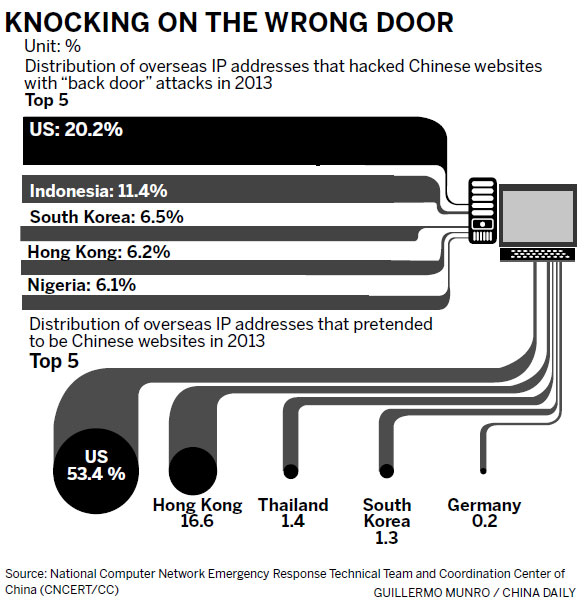
But of these hacked computers, roughly 10.9 million were attacked by more than 29,000 threats originating from overseas Internet provider addresses and servers, the center said.
"It means overseas online attacks are still major problems for the cybersecurity of our country even if the total number of affected computers dropped," said Wang Minghua, director of administration and operation department at the center.
Among the IP addresses listed as threats in the report, 8,807 originated from the United States. US threats were responsible for hacking into 4.49 million computers in China, the report said.
The highest number of threats came from the US, followed by South Korea and Hong Kong, it said.
Approximately 31,000 overseas computers controlled 61,000 websites in China with so-called backdoor attacks last year, according to the report. Although the number of foreign cyberattacks dropped 4.3 percent from the previous year, the number of controlled websites increased by 62.1 percent, the report said.
"To curb these online problems, the Chinese government used numerous cybersecurity measures late last year in a move to build the nation's protections against attacks," Wang said.
By the end of last year, an office of Internet security affairs was established by the Foreign Ministry to help the country tackle hacking, Wang said.
President Xi Jinping also ordered a central Internet security and informatization leading group in February to deal with cybersecurity issues on the national level, Wang said.
"I'm looking forward to the cybersecurity laws that can be established under the central government leading group," said Wang, who added that the Chinese top legislature has begun the task of improving the center.
Both cybersecurity specialists and political advisers during the recent two sessions called on the country's legislators to write new regulations against hacking. Many of them shared their ideas online to solicit opinions about what should be done to prevent cyberattacks.
Zhang Xiaoling, a political adviser, suggested that the government should guide any upcoming laws, but that ideas should be collected from online companies and Chinese consumer associations to provide netizens a safe environment and to improve the nation's credibility on the Internet.
Gao Wen from the Chinese Academy of Engineering said a list of reputable websites should be established.
Gao added that other Internet problems, such as the spreading of online rumors, must be solved in a timely manner and that the establishment of the websites list will be better for network transparency.
caoyin@chinadaily.com.cn


Copyright 1995 - . All rights reserved. The content (including but not limited to text, photo, multimedia information, etc) published in this site belongs to China Daily Information Co (CDIC). Without written authorization from CDIC, such content shall not be republished or used in any form. Note: Browsers with 1024*768 or higher resolution are suggested for this site.
License for publishing multimedia online 0108263 Registration Number: 130349