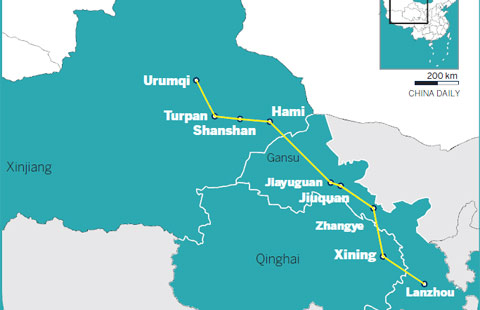
The electricity grid is being upgraded to help combat smog in major cities.
As of January, China had completed the construction of five ultrahigh-voltage transmission lines; two more had been submitted for approval and another six were in the pipeline, an official from the State Grid said recently.
"The ultrahigh-voltage transmission lines can transmit power from western China to the east, optimize the energy distribution system, increase efficient use of clean energy and improve the eco-environment in Central China," said Zhang Zhengling, deputy director of the State Grid's development-and-planning department.
Zhang was speaking at an event held by the China Association for Science and Technology in Beijing.
The major coal-mining areas are in Shanxi and Shaanxi provinces and the Inner Mongolia autonomous region, far from the power-hungry cities in eastern and central China.
Before ultrahigh-voltage transmission lines came into operation, coal was transported long distances to small power stations near large cities.
The ultrahigh-voltage transmission network — which refers to 1,000-volt alternating current transmission or 800-volt direct-current transmission — reduces transmission losses significantly, allowing long-distance transmission of electricity instead of coal.
"Replacing coal transportation with power transmission across the country, according to our own estimates, may reduce pollution haze in East and Central China by 23 percent or 25 percent from 2012 to 2020," Zhang said.
Gao Liying, deputy director of the State Grid's ultrahigh-voltage construction department, also noted the pollution reduction possible by the upgraded grid.
"A survey by Greenpeace last winter looked at 196 power plants in Beijing, Tianjin and Hebei. The result showed that 100 million kilowatt-hours transmitted by ultrahigh-voltage transmission lines could cut the PM2.5 emissions of the load center by 7 tons, and reduce PM10 release by 17 tons," he said.
Earlier reports said that the total electricity consumption in Beijing was 91.3 billion kilowatt-hours. The city's annual PM2.5 emissions could be reduced by 6,391 metric tons and PM10 by 15,521 tons if the ultrahigh-voltage transmission networks replace all the small power plants near the city.
"The combustibility of coal contributes 18 percent to the emissions of PM2.5. It is fair to say that coal burning is a major source of pollution haze," Gao said, adding that in some of the most prosperous regions of East and Central China, coal consumption exceeds 3,000 tons per square km every year.
"And these regions are the areas that had the most severe pollution haze," Gao said.
In addition to changing the layout of power plants, the ultrahigh-voltage network can also promote clean energy, Gao said.
"North China has abundant thermal, wind and solar power, while Southwest China has hydropower. With an ultrahigh-voltage network, we can bundle thermal power together with wind power, or wind power together with solar power, to ensure a steady load as well as greener power generation," he said.


Copyright 1995 - . All rights reserved. The content (including but not limited to text, photo, multimedia information, etc) published in this site belongs to China Daily Information Co (CDIC). Without written authorization from CDIC, such content shall not be republished or used in any form. Note: Browsers with 1024*768 or higher resolution are suggested for this site.
License for publishing multimedia online 0108263 Registration Number: 130349