No need to pit China against US
Updated: 2013-06-01 09:16
(Xinhua)
|
|||||||||


SINGAPORE - It's obvious that there is no need to pit a rising China against the United States -- even as a Pacific power.
Well, maybe not so obvious. At least not so to a South Korean participant at the ongoing Shangri-La Dialogue who posed the question "Do you have more trust in the United States versus China "to keynote speaker Vietnamese Prime Minister Nguyen Tan Dung on Friday evening.
Some of the distinguished scholars are saying that while China should fully expect suspicion over its peaceful rise and trouble in its neighborhood over the coming decades, both China and the United States understand that they have common interests in peaceful and reliable bilateral relations.
"I think it is not enough for China and the United States to know this, the message should be conveyed to other countries and regions in the Asia Pacific, too, where both the United States and China have an influence," said Zheng Yongnian, director of the East Asian Institute, the National University of Singapore.
This will be in the interest of not only China and the United States, but other players in the region as well.
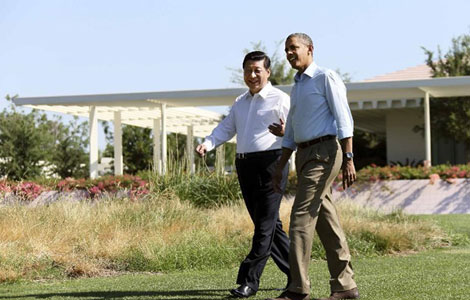
Chinese leaders have called for a new type of bilateral relations between the world's two biggest economies.
While China is pursuing a strategy of peaceful rise, it is by no means in the interest of the United States, either, to be involved in any conflict in the world of today.
It cannot be denied that the two countries have certain doubts over each other's strategic intentions, with Washington fearing its global status overtaken while Beijing always wondering about the true purpose of Obama's so-called "Asia Pivot" and " rebalancing."
To reduce suspicion and build trust, it is vital to have channels for dialogues, including those like the multilateral Shangri-La Dialogue, which gathers defense ministers and senior military commanders from some 30 countries and regions, mainly those in the Asia Pacific.
Kishore Mahbubani, a former Singaporean diplomat and dean of the Lee Kuan Yew School of Public Policy, said the different countries in the world are now living in many "different cabins on the same boat," unlike in the past when they live in different boats.
He called for major powers, especially the United States, to push for respect for rules in global governance.
Zheng also said, "it is possible to have new type of relationship between the major powers as the interdependency grows in a shrinking global village."
China has been developing by integrating into the global system. From its perspective, a peaceful environment is in its interest. China has so far held steadfast to its strategy of peaceful rise despite the seemingly provocation and has spared no effort to repeatedly assure other countries that it is in pursuit of peace and development.
From the U.S. perspective, it should also make efforts to explain its pivot to Asia to countries in the region in a way that does not create "unintended consequences," as maintained by Bonnie Glaser, a senior adviser for Asia in the Freeman Chair in China Studies at the Washington-based Center for Strategic and International Studies.
There is no coincidence that China has been experiencing more problems increasingly with its neighboring countries as the United States spread the message of its "pivot to Asia." Indeed some of the countries are having the mentality of "seizing the opportunities" before China's further growth.
It is not that China may view it with suspicions, but that this might give misperceptions to other countries in the region that they should either side with the United States or China.
Singapore has made it clear in the past that it does not want to be forced to choose.
But they don't have to, as even both China and the United States know that the interdependency between them far outweighs the competition, that is, if you do see the bilateral relations from a strategic point of view.
Related Stories
China-US summit prospects 2013-05-22 07:51
Spokesman highlights China-US summit 2013-05-21 23:59
Schedule