China's power transfer mechanism more mature
 Comments
  Print
Print  Mail
Mail  Large Medium Small
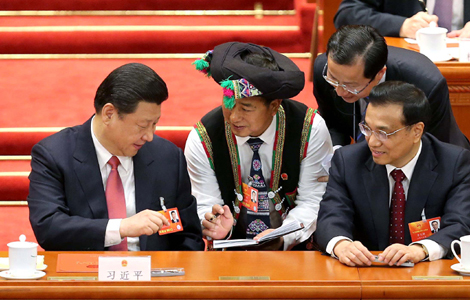
BEIJING - China completed an orderly and institutionalized transition of power at the end of an annual session of China's top legislature here Saturday with President Xi Jinping heading the fifth generation of the Chinese leadership.
The once-in-a-decade handover is the third generational power transfer and sixth term-of-office change of the Chinese leadership since the current Constitution, a watershed in the development of China's leadership transition mechanism, was promulgated in 1982.

Mao Zedong (1893-1976), founder of New China, who represented the first generation of the Chinese leadership, never retired from China's top post until his death in 1976.
Deng Xiaoping (1904-1997), who led the second generation of the Chinese leadership, stepped down as China's senior leader at the age of 85. His successor, former President Jiang Zemin, who was at the core of the third generation of the Chinese leadership, handed over the helm of the Communist Party of China (CPC) to Hu Jintao at the age of 76.
Hu was not yet 70 years old when he handed over the Communist Party's leadership to Xi Jinping at the 18th National Congress of the Communist Party of China (CPC) held in Beijing in November 2012.
Institutionalization and standardization are the two main features of mechanism maturity fully displayed in the change of China's power structure at the annual session of the National People's Congress (NPC) this month.
Drawing an end to the longstanding practice of de-facto life tenure for senior leaders, China's Constitution stipulates that holders of the country's top leading posts, except for the chair of the Central Military Commission, shall serve no more than two consecutive five-year terms.
Since then, the leadership replacement every five years is popularly referred to as a term-of-office change, and the once-in-a-decade power transfer a generational change.
The installation of the fifth generational leadership, led by President Xi, culminates a long process of gradual improvement of China's leadership transition mechanism.
Neither the tenure of the first generation of chief leaders of China was subject to any time limit, nor was there an established mechanism for power handover.
During the Cultural Revolution which ran from 1966 through 1976, China's Constitution was trampled on, with the mechanism of the People's Congress sabotaged and the rights of citizens violated.


Copyright 1995 - 2010 . All rights reserved. The content (including but not limited to text, photo, multimedia information, etc) published in this site belongs to China Daily Information Co (CDIC). Without written authorization from CDIC, such content shall not be republished or used in any form. Note: Browsers with 1024*768 or higher resolution are suggested for this site.
License for publishing multimedia online 0108263 Registration Number: 20100000002731 