Comments
  Print
Print  Mail
Mail  Large Medium Small
BEIJING - Like many migrant workers, Huang Ying, 45, has scant interest in the outcome of China's top-level reform meeting, but when told about possible changes concerning her land in the countryside, she knows what's in her best interest.
"I would not sell my land even I were allowed to, but leasing or mortgaging it would be good," the gardener in Haikou, capital of south China's Hainan Province, told Xinhua on being told that farmers will soon have more liberty with their land-use rights.
In China, urban land is owned by the state and rural land is normally under collective ownership. While gradual reforms since 1987 saw the trading of urban land evolve into a vigorous property market that became a major growth driver, land in the countryside remains largely static.
Under China's land regulations, farmers only have rights to use, but cannot directly sell or mortgage, land. They must first be acquired by a local government before being used for development.
The policy usually results in disputable land takings with meager compensation for farmers, and for those like Huang who want to make a living in the cities, restrictions on land transfer mean they have to start afresh on their urban journey.
That is set to change.
LAND REFORMS
China's new leadership has determined to build a fairer mechanism to narrow the urban-rural divide and maintain social stability during its urbanization drive.
Among the key reform decision publicized on Friday by the Communist Party of CHina Central Committee, integrated development in villages and cities is a major highlight.
China is to build a unified market for urban and rural construction land, meaning land used for non-agricultural purposes. Previously, the official wording is to "gradually" achieve such a unification.
Li Ping, senior attorney for Landesa Rural Development Institute in Beijing, a nonprofit organization focusing on securing land rights for the poor, sees the move as a light at the end of the tunnel of a long controversial land expropriation regime.
"Allowing market transactions of rural construction land means farmers could negotiate directly with developers, taking local government out of the equation and enabling farmers to negotiate for the true value of their land," Li wrote in a research note.
On the precondition that the scale of farmland is guaranteed, farmers will also be allowed to transfer and mortgage their land-use rights, or turn the rights into shares in large-scale farming entities, according to the document.

 Dujiangyan restores traditional meeting etiquette
 3D light show displayed in Shanghai
 It's hard to say goodbye
 Village school faces enrollment decrease
 Group dancing limited in S China
 Massive fish spill in C China
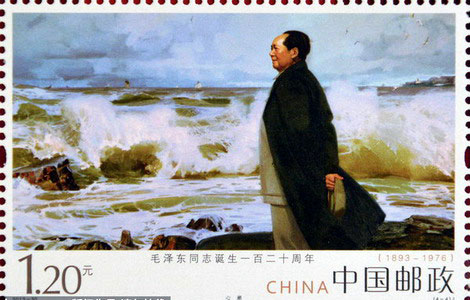 Stamps commemorate 120th anniversary of Mao's birth
 China's changing fashion since 1978
Copyright 1995 - . All rights reserved. The content (including but not limited to text, photo, multimedia information, etc) published in this site belongs to China Daily Information Co (CDIC). Without written authorization from CDIC, such content shall not be republished or used in any form. Note: Browsers with 1024*768 or higher resolution are suggested for this site.
License for publishing multimedia online 0108263 Registration Number: 20100000002731