Comments
  Print
Print  Mail
Mail  Large Medium Small
 |
|
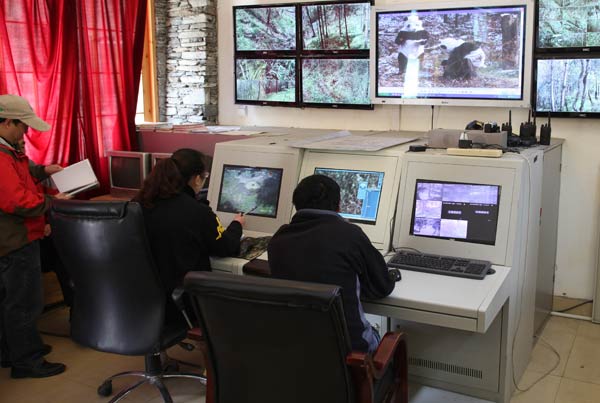
Wolong's staff tracks pandas' daily activities through monitors to learn how to release them to the wild. Human contact is minimized and staffers wear panda suits when interacting with the animals, as seen on the top screen.PHOTOS BY HUO YAN / CHINA DAILY |
"Most will be relocated to the new Wolong," Li says, adding that about 500 of the 2,500 surrounding residents have been moved to make room for the animals. The cleared areas are being reforested.
"People were happy to move because they realize pandas are important," Li says. "And they know tourism will boom once the park reopens, bringing income opportunities."
Also, moving off the mountains makes residents safer, he adds.
Wolong's administrative bureau chief, Zhang Hemin, says buildings "swayed" and "cracked" but didn't fall in the Ya'an quake. In the 2008 disaster, one panda died and another disappeared.
"The animals have psychologically recovered (after 2008)," Li says. "Some took a month. Some took six."
Wolong's experts have been researching how quakes affect captive and wild pandas.
"This is a rare opportunity to examine this," forest engineer Zhou Shiqiang says. "The results haven't come out yet, but our hypothesis is there will be a vast difference."
Wu Daifu, director of Wolong's reintroduction department, explains: "Pandas have been dealing with disasters, such as quakes, for millions of years. The wild animals seem to have adapted, but the question is how. Captive pandas were deeply affected."
The base's bears were terrified, he recalls. Some climbed trees and did not come down until workers went up after them.
The 2008 quake presented opportunities to study and perhaps save pandas, but disrupted plans to release a second panda into the wild that year. But Wolong's researchers say they have been making progress. They are training five cubs for release and plan to let two go this year and three next year.
The breakthrough has been limiting human interaction from birth, Li says. Contact is minimized and handlers wear panda suits whenever in the creatures' sight.
The first time a panda was released at the reserve — and in the world — was in 2006. However, Xiang Xiang did not survive the winter. He was 2 years old when released and lived only about 10 months.
The second reintroduction, of a bear with less human contact, took place in October. That panda survived the cold.
"There's less food and more competition in the winter," Li says. "We can't be sure the second release will work. But, so far, so good."
 Cherry blossoms turn Tongji University must-see site
 How Chinese companies are contributing to US society
 Fantastic 'tree paintings' seen in Anhui province
 Tracing nationwide Tomb-sweeping Day travel rush
 Ex-inmate runs free school for poor children
 Shanghai's iconic Grand World reopens on 100th anniversary
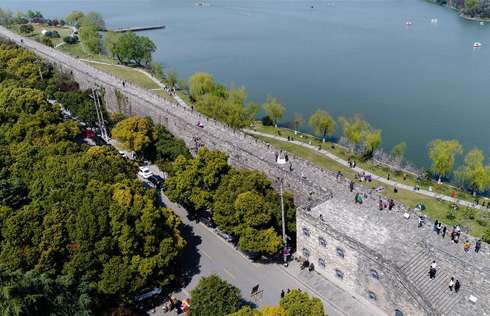 Spring scenery across China
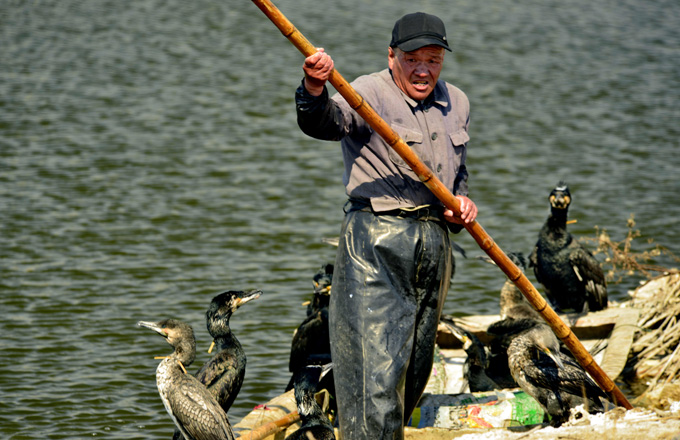 Making a living with fine-feathered friends
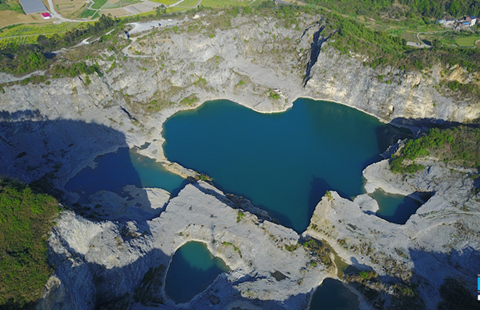 Heart-shaped pond found in Chongqing, Southwest China
 Ten photos from across China: April 1-6
 British PM May, EU's Tusk meet on Brexit, talks positive on both sides
 French presidential debate reveals schism over Europe
 Chinese F1 Grand Prix: 10 fast facts
 China beat Croatia 2-0 at CFA Team China International Football match

Copyright 1995 - . All rights reserved. The content (including but not limited to text, photo, multimedia information, etc) published in this site belongs to China Daily Information Co (CDIC). Without written authorization from CDIC, such content shall not be republished or used in any form. Note: Browsers with 1024*768 or higher resolution are suggested for this site.
License for publishing multimedia online 0108263 Registration Number: 20100000002731