

China's market, investment and labor forces could assist
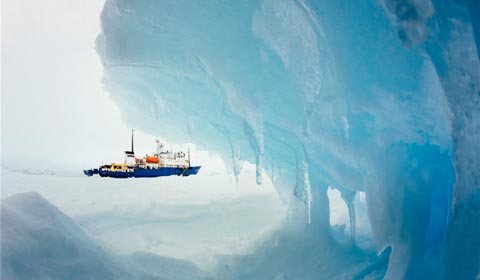
China can play a bigger role in the increasingly ice-free Arctic, using its investment advantages and the size of its markets and labor force, but it is "far from becoming a power player in the Arctic", said the head of the polar strategic research division under the Polar Research Institute of China.
"As a latecomer, China has a lot of homework to do to learn more about the rapidly changing region and then to better serve the country's development," Zhang Xia, who is also deputy chief of the new China-Nordic Arctic Research Center, told China Daily.
On Dec 10, the center in Shanghai was officially inaugurated when 10 research institutions from China, Iceland, Denmark, Finland, Norway and Sweden signed an agreement to boost cooperation in Arctic research.
Zhang's comments came amid increased jostling by the major Arctic powers for control in the region, which is believed to hold rich mineral and energy resources as well as emerging shipping opportunities.
The five nations with territory near the Arctic circle — Canada, Norway, Russia, the United States and Denmark (through Greenland) — are currently allotted an exclusive economic zone of 200 nautical miles from their northern coasts.
In December, the Canadian government asked scientists to work on a submission to the United Nations, saying that the outer limits of Canada's territory include the North Pole.
Shortly after Ottawa's announcement, Russian President Vladimir Putin ordered Russia's military to increase its focus on the Arctic. Moscow made a similar claim to the UN in 2001.
The rising political temperature in the Arctic coincided with the latest wave of suspicion about China's "ambition" in the region, after it gained long-awaited observer status in the Arctic Council in May.
Although China has no voting rights in the intergovernmental forum grouping Canada, Denmark, Finland, Iceland, Norway, Russia, Sweden and the US, its admission still seemed to have left many wondering whether a paradigm shift in geopolitics was taking place in the Arctic.
Zhang said China's great distance from the Arctic and its limited research experience prevent it from playing a leading role in the region at the moment.
"However, these obstacles do not mean China cannot participate in Arctic affairs," Zhang said. "Instead, China's investment, market and labor forces could help the sparsely populated Arctic countries improve the region's incomplete infrastructure in transportation and natural resources development."
Research shows that the Arctic is expected to become ice-free in coming decades as temperatures there rise twice as fast as in the rest of the world. There is an increasing possibility of a much shorter commercial sea route and a longer navigable period in the Arctic Ocean.
"The shorter and safer route through the Arctic would cut thousands of kilometers — and considerable costs — off the journey from China to trading partners like Europe," said Zhang. "Cheaper shipping would also bring the cost of the region's natural resources down and help deliver them to the international market more easily," he said.
"But before that, the region's infrastructure badly needs improvement."
The US Geological Survey estimates that there are 90 billion barrels of oil north of the Arctic Circle, enough to fuel the world for three years at current consumption rates. Most of the oil is within the uncontested jurisdictions of Norway, Russia, Canada, Denmark and the US.
However, offshore oil drilling is challenging and expensive. Difficulties such as long distances, harsh weather and poor infrastructure require advanced technologies and vast amounts of funding.
Canada lacks roads and pipelines to its Arctic coast and has just one deep-water Arctic port, located in Hudson Bay, far south of the Arctic Circle. The US has no Arctic ports and faces massive costs to repair damage being caused to existing roads, pipelines and buildings by melting permafrost, Michael Byers, a professor of global politics and international law at the University of British Columbia, said in an article earlier this year.
"If Beijing were to offer concrete and lasting benefits, such as funding for ports and other multiuse infrastructure, Chinese investments in Arctic offshore oil would be looked upon more favorably," he wrote.
Zhang said China's interest and investment in the Arctic are not for resource plundering.
"It is clear that these resources are not ours, but they could diversify and secure China's energy sources. For China, it is about having more options in case of emergency, and for the Arctic countries, it is about having one more market," he said.
"Many Arctic issues besides energy concern the whole international community," he added.
According to Zhang, climate changes in the Arctic, which have a global impact, have driven countries in the region and beyond to examine the links. Extreme weather in northern and eastern China, for instance, can be predicted by calculating the shrinking size of sea ice in the Arctic.
When sea ice in the Arctic melted to a record low last summer, the biggest snowstorm in five decades hit Heilongjiang province in the spring, he said.
Zhang said China should focus on polar studies by enlarging its still small research team and strengthening communications with the front-runners in polar research, such as the Nordic countries.
"The future role of China in the Arctic will be decided by its scientific capability and its relations with the powers there. The establishment of the China-Nordic Arctic Research Center is just the beginning," he said.
|
|
|
|
|
|
|
|

Copyright 1995 - . All rights reserved. The content (including but not limited to text, photo, multimedia information, etc) published in this site belongs to China Daily Information Co (CDIC). Without written authorization from CDIC, such content shall not be republished or used in any form. Note: Browsers with 1024*768 or higher resolution are suggested for this site.
License for publishing multimedia online 0108263 Registration Number: 20100000002731 














 Op Rana
 Berlin Fang
 Zhu Yuan
 Huang Xiangyang
 Chen Weihua
 Liu Shinan