Comments
  Print
Print  Mail
Mail  Large Medium Small
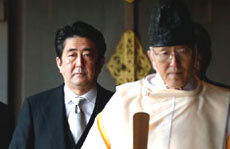
BEIJING -- Japanese Prime Minister Shinzo Abe's visit to the war-linked Yasukuni shrine has aroused worldwide condemnation with officials and media warning of its adverse impact on the regional peace and stability in East Asia.
Chinese Foreign Minister Wang Yi on Thursday afternoon summoned Japanese Ambassador to China Kitera Masato, saying that "China will not tolerate it."
Wang said Abe's visit ran contrary to the commitment made by former Japanese administrations and leaders on historical issues, and erected a major new political obstacle to the already strained China-Japan relations.
South Korea, which also suffered deeply from Japanese aggression during World War II, on Thursday denounced Abe's shrine visit as "deplorable" and warned that it jeopardized bilateral ties.
 |
"Our government cannot repress condemnation and rage over Prime Minister Abe's paying of respects at the Yasukuni shrine that glorifies its colonial aggressions and enshrines war criminals," Culture Minister Yoo Jin Ryong said in a statement on behalf of the South Korean government.
The United States, Japan's key ally, voiced its disappointment over Abe's visit to the shrine.
"Japan is a valued ally and friend. Nevertheless, the United States is disappointed that Japan's leadership has taken an action that will exacerbate tensions with Japan's neighbors," the US embassy in Japan said in a statement on its website.
Abe's reckless move also drew criticism from global media.
Major US newspapers on Thursday published articles saying his visit to the controversial Yasukuni shrine spurred new tension in Asia and further aggravated Japan's ties with China and South Korea.
The Washington Post reported that Abe's visit caused fresh concerns for the US President Barack Obama's administration, which has encouraged Abe to reconcile with Japan's neighbors.
The visit "raises the prospect of even deeper hostility between an already isolated Tokyo and its neighbors," said the newspaper.
"The visit seemed to make it obvious that Mr. Abe's economic policies were a guise to hide his nationalistic intent," the Wall Street Journal quoted Koichi Nakano, a political science professor at Sophia University in Tokyo, as saying.
"This shows how arrogant Abe is toward the neighboring countries, how unrepentant Japan is about its past war crimes," the New York Times quoted Yang Soon-im, who runs the Association for the Pacific War Victims, as saying.
British broadcaster BBC analyzed Abe's motive in visiting the shrine regardless of the fact that it is highly offensive to China and South Korea, saying that is firstly because he wanted to.
Quoting close observers of the Japanese prime minister, BBC said that he is at heart a nationalist and a historical revisionist and believes the trials that convicted Japan's wartime leaders were "victors' justice".
Secondly, with the right wing of the Liberal Democratic Party as his main support base, Abe wanted to show them that he is a tough guy who is not afraid of China, said BBC.
"Trampling on the neighbors' sensitivities about their shared past also limits room for managing territorial disputes involving both countries (China and South Korea) or making headway on a range of other pressing issues," Jeff Kingston, director of Asian studies at Japan's Temple University, told CNN.

Copyright 1995 - . All rights reserved. The content (including but not limited to text, photo, multimedia information, etc) published in this site belongs to China Daily Information Co (CDIC). Without written authorization from CDIC, such content shall not be republished or used in any form. Note: Browsers with 1024*768 or higher resolution are suggested for this site.
License for publishing multimedia online 0108263 Registration Number: 20100000002731