

 |
|
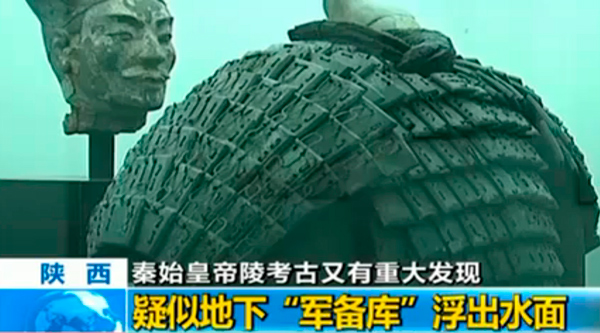
A video grab shows a set of stone armor unearthed from the mausoleum of Qin Shihuang, founding emperor of the Qin Dynasty (221—206 BC), in Xi'an, Shaanxi province.[PHOTO BY CCTV] |
Archaeologists have found what they believe to be an underground arsenal in Xi'an, the capital of Shaanxi province, at the mausoleum of Qin Shihuang, founding emperor of the Qin Dynasty (221-206 BC).
The Emperor Qin Shihuang's Mausoleum Site Museum in the city's Lintong district says archaeologists excavating a burial pit at the cemetery have found many examples of stone armor and helmets.
Some of the stone armor has been repaired, Zhang Weixing, deputy director of the museum's archaeology department, told China Daily.
"You can see that every flake of the stone armor is linked by thin bronze strands and it can roll and flex, providing free movement for the ancient soldiers who wore it.
"From one repaired stone helmet, you can see that every stone flake has a different radian, meeting the contours of the wearer's face, and the part of the helmet near the wearer's shoulder has a curved recess, matching the structure of the human body," Zhang said.
After examining the newly discovered relics, the archaeologists said they may have unearthed an underground armory next to the emperor's tomb.
The pit, about 200 meters southeast of the mausoleum, is 130 meters long from west to east and 100 meters wide. Occupying 13,000 square meters, it is the largest burial pit found inside the mausoleum.
After a trial excavation of the pit, the archaeologists found many stone flakes linked with thin bronze strands, which could be repaired to form 87 pieces of armor and 43 helmets.
Experts said the armor and helmets were probably cut from large stones and then fine-sanded to make the thin flakes. Holes were then drilled into the flakes and they were linked by bronze strands.
The armor mainly consists of two large pieces, protecting the ancient soldiers'chests and backs, and some pieces also cover the arms and shoulders.
The helmets are 30 cm high, from the top of the head to the shoulder.
Experiments completed by the archaeologists show that it would have taken a man, working eight hours a day, between 344 and 444 days to complete a piece of armor comprising 600 stone flakes.
"There are more than 5 million flakes in the pit, and from these we know that the manufacture of the stone armor and helmets required a huge amount of labor in ancient times," Zhang said.
Experts think that more than 1,000 pieces of armor and helmets will be found if the whole pit is excavated.
The archaeologists also found some stone armor for horses and some bronze parts for horses and chariots.
Experts said the texture of the newly discovered relics is very different to that of the Terracotta Warriors and Horses.
"The production technique for the stone armor is much more sophisticated," Zhang said.
Historical data show that armor and helmets were mainly made from leather during the Shang Dynasty (c. 16th century -11th century BC), Western Zhou Dynasty (c. 11th century-771 BC) and the Eastern Zhou Dynasty (770-256 BC).
The stone armor and helmets made in the Qin Dynasty using advanced manufacturing techniques will provide significant information for studying social and technical developments in ancient times, experts said.
Zhang said some of the newly discovered armor was scale armor used by high-ranking officials and thought to have been made during the Western Han Dynasty (206 BC-AD 24).
The Qin Dynasty was China's first unified dynasty, with Qin Shihuang (259-210 BC) its founding emperor.
Construction of his mausoleum took 37 years.
The Terracotta Warriors and Horses were found in 1974 and the museum was built in 1979.
Contact the writer at malie@chinadaily.com.cn
|
|
|
|
|
|
|
|

Copyright 1995 - . All rights reserved. The content (including but not limited to text, photo, multimedia information, etc) published in this site belongs to China Daily Information Co (CDIC). Without written authorization from CDIC, such content shall not be republished or used in any form. Note: Browsers with 1024*768 or higher resolution are suggested for this site.
License for publishing multimedia online 0108263 Registration Number: 20100000002731 


















 Op Rana
 Berlin Fang
 Zhu Yuan
 Huang Xiangyang
 Chen Weihua
 Liu Shinan