Comments
  Print
Print  Mail
Mail  Large Medium Small
 |
|
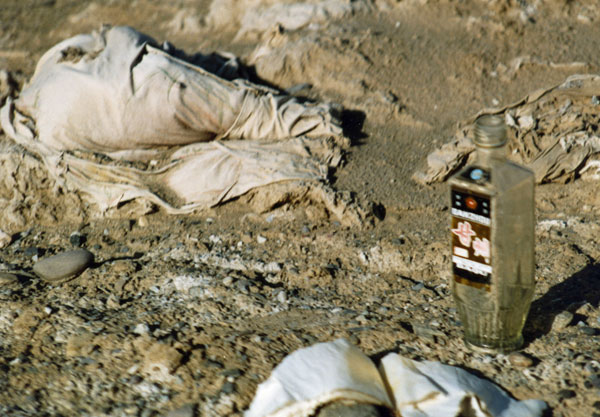
Someone has paid tribute to the deceased with a bottle of liquor. [Photo provided to China Daily] |
Evolution of laojiao
However, by this time, laojiao was no longer associated with political stance. Instead, it was mainly used to detain people for minor offenses such as petty theft and prostitution. Under Chinese law, these offenses are not serious enough for those who commit them to be tried by the courts and sent to prison. That's where laojiao came in, viewed by its defenders as a solution to a social malaise that many believed was a byproduct of an increasingly commercialized society.
"From its very beginning, laojiao was the closely guarded turf of the police, which issued the orders, but under the name of a local laojiao committee. How could the right to issue such an order be given to the same men who turned up at people's doors and took them away?" asked Song. "Realizing the consequent abuse of power, the central government sought to alleviate the situation by introducing judicial reviews and legal counsel, which in reality were often denied to laojiao detainees."
Another contradiction, according to Zhou, was that laojiao detainees, who by definition are not criminals, were often detained for periods far longer than many criminal sentences.
"Laojiao didn't have a time limit until the 1980s. Then, it was decided that the typical sentence would be one to three years, with the possibility of a one-year extension. Keeping in mind that the minimum criminal sentence is one month, that arrangement appears illogical, even absurd," he said. "Little wonder I have met people undergoing re-education punishment but begged to be convicted and sent to prison."
It's estimated that 310 laojiao were in operation in 2007, and in April that year, a group of leading scholars drafted an open letter calling for the abolition of the system.
In the years that followed, the calls gained momentum as laojiao became entangled with another hotly debated policy - xinfang, or "letters and calls", a nationwide form of petitioning through which a person can take his grievances to xinfang bureaus from the local level all the way up to the head office in Beijing.
"Xinfang has always been there, since 1949. But in the past 15 years, it has started to gain widespread public attention, because the sheer amount of controversy it generated seems to have overshadowed its original goal," said Wei Rujiu, a lawyer in Beijing. "When the government first shifted its emphasis toward xinfang, in the early 1990s, it was to check the conduct of local governments and improve the transparency of legal proceedings at local courts. However, since all decisions made by xinfang bureaus are basically administrative ones, the policy has unintentionally weakened the authority of court rulings."
A chain reaction occurred: Knowing that court rulings are often subject to challenges, dissatisfied parties in a legal case would then engage in a seemingly endless process of petitioning, working from the lowest to the highest authorities. In desperation, some went on hunger strike or laid siege to xinfang bureaus and their personnel.
Besieged by petitioners, the State Bureau for Letters and Calls called on local governments to keep the trouble within their own territories. Officials who failed to do so were marked down in their annual appraisals, so they instigated measures to prevent people from traveling and making their cases in Beijing, a practice known as "intercepting".
"It would be an exaggeration to say that repeat petitioners accounted for the bulk of laojiao detainees in recent years, but some of them were indeed thrown into the camps by their local government to be 're-educated,'" said Wei. "In the worst cases, laojiao was used to stop people petitioning against local governments in relocation or land condemnation lawsuits. That emboldened some local officials to gain revenge without the law entering the equation."
One high-profile 2006 case involved a woman from Yongzhou in Hunan province, whose 11-year-old daughter had been gang-raped and forced into prostitution. Two of the six men convicted were given the death sentence and two were jailed for life. The other two were sentenced to 15 and 16 years. Dissatisfied and determined to pursue the death penalty for all six men, the woman began petitioning the local xinfang. However, when she took her case to Beijing, the local authorities became involved. In August 2012, the mother was given a laojiao sentence of 18 months, but only served nine days because of the intensive, sympathetic media coverage of the case. She sued the local laojiao committee, and a high court ruled in her favor in July this year, just four months before the CPC Central Committee announced the abolition of the system.
"That mother not only won her case, she helped to expedite the demise of laojiao by fixing national attention on the issue and turning a no-go area into the hottest Internet search word," said Wei.


Copyright 1995 - . All rights reserved. The content (including but not limited to text, photo, multimedia information, etc) published in this site belongs to China Daily Information Co (CDIC). Without written authorization from CDIC, such content shall not be republished or used in any form. Note: Browsers with 1024*768 or higher resolution are suggested for this site.
License for publishing multimedia online 0108263 Registration Number: 20100000002731