Comments
  Print
Print  Mail
Mail  Large Medium Small
 |
|
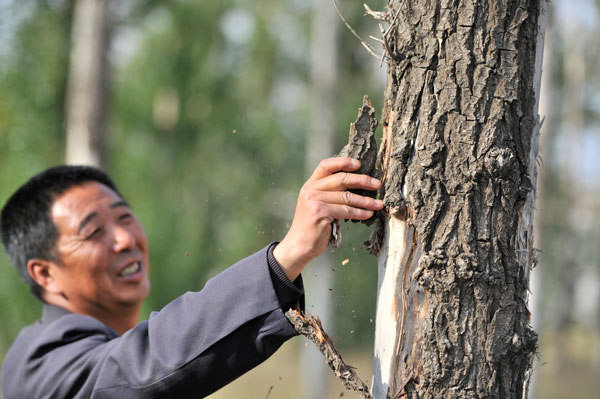
Zhang Shaoyun, 53, a ranger at a forest in Zhangjiakou, Hebei province, easily rips off a piece of bark from a dead poplar tree. The poplars began withering at the forestry farm in September. The forest was planted to act as a shield against sandstorms. Jiang Guidong / for China Daily |
A forest planted decades ago to prevent sandstorms from hitting northern China is in a severe state of decay.
The tree line covers more than 102,000 hectares of northern Zhangjiakou, a city in Hebei province about 200 kilometers from the capital.
According to forestry officials, 92 percent of the poplars last year were "hypermature", meaning they have been decaying for a decade. A third of the forest is dead or dying and 48,800 hectares are growing poorly.
Many trees are bare and weak, said Zhang Shaoyun at Zhangbei county's Central Forest Farm.
"The bark can easily be torn off, and a man could even push one over," said the ranger of 32 years. "The decaying trees have spread quickly, and tens of thousands of trees are withering every year, leaving few left."
The vast forest was first planted in the city's Bashang area in 1967, with the aim of sheltering Beijing from sands blown from the north and west.
In Zhangbei, the number of days of heavy wind dropped from more than 90 in 2002 to about 30 last year. Sandstorms hit on only four to six days, compared with 26 a decade earlier.
However, the withering forest — part of northern China's network of shelterbelts — is proving less effective, meaning cities face an increased risk of sandstorms.
The decay "will definitely impact the cities downwind, including Beijing", predicted Wang Jinhuan, deputy director of Zhangjiakou forestry bureau.
According to national standards, the poplars that have stood in northern China for more than 30 years are hyper-mature.
"Frequent drought and barren soil have also accelerated the process," Wang said.
A report on the city's water sector also showed that the protective forest has witnessed a continuous decline in underground water levels, dropping at least 1 meter a year between 2000 and 2010.
"Another important reason for the decaying green belts is that the tending operation has fallen behind," Wang said.
The farm, as well as the county and city governments, attributed the insufficient maintenance to a lack of allocation.
Public forests are forbidden by law from tree felling to protect the environment.
In addition, the barren soil cut the ways of making money from planting commercial plants like fungus, and the dried trees made the trunk worthless.
"We have to sell saplings and rent houses surrounding our farms," said Liu Zhisheng, director of the Central Forest Farm.
The farm's total annual income is about 700,000 yuan ($115,000).
"It barely covers salaries for our 25 workers, who patrol the farms every day to guard against felling and fires," he said.
"There is little money from the farm to build ditches to water the forest or other necessary construction, so the trees live at the mercy of the elements."
There are four ways of reforestation, of which clear cutting is the first choice for the protective forest in Zhangjiakou.
"More than half of the trees are dead, making the woodland lose the ability of self-renewal, thus other methods involving planting new trees from the living branches are not applicable," said Zhao Shunwang, deputy director in charge of updating programs.
About 667 hectares of dead forest had been replanted by May in Mantouying township, and these saplings can grow into trees to catch blowing sand in four to five years.
"But it's not fast enough to reforest all the decaying and protect the downwind cities," he said. "More important, we cannot afford the large investment into this program."
The average investment was 19,950 yuan per hectare in the pilot program of Mantouying.
The four counties of Bashang, including Zhangbei, are not well-off and lack the means to allocate millions of yuan to reforestation.
Authorities in Hebei and Zhangjiakou have jointly handed in a feasibility study on updating the hypermature forest in Bashang, saying 558 million yuan will be allocated to update the dead poplars of the 33,800 hectares.
They have applied for approval from the central government.
"The lack of allocation in tending forest exists in many shelterbelt programs in Hebei," said Zhao Yanbin, an expert with the forestry bureau in nearby Shijiazhuang.
He said his research had shown many programs in other cities faced similar difficulties.
"For the deteriorating air quality, it's urgent to guarantee the forest works well, and to that goal the country needs to file policies to encourage the public to participate into the protection," he added.
zhengjinran@chinadaily.com.cn


Copyright 1995 - . All rights reserved. The content (including but not limited to text, photo, multimedia information, etc) published in this site belongs to China Daily Information Co (CDIC). Without written authorization from CDIC, such content shall not be republished or used in any form. Note: Browsers with 1024*768 or higher resolution are suggested for this site.
License for publishing multimedia online 0108263 Registration Number: 20100000002731