

Mission would be first landing of lunar probe in nation's space program
 |
|
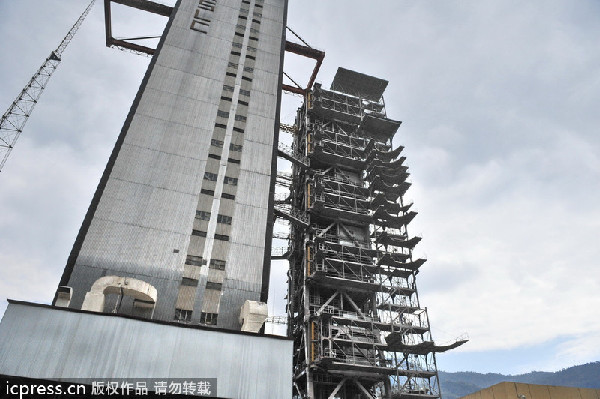
China will launch the Chang'e 3 lunar probe at 1:30 am on Monday from the Xichang Satellite Launch Center. [Photo/icpress.cn] |
If everything goes as planned during the launch, set for 1:30 am on Monday, the lunar probe will land in mid-December, Xichang Satellite Launch Center sources said over the weekend.
Two hours before the planned liftoff, officials at the Beijing Aerospace Control Center announced that everything was "going well" for the mission.
The Chang'e-3 spacecraft's carrier, a Long March-3B rocket, began to be loaded with cryogenic fuel on Sunday afternoon, said Li Benqi, head of launch tests at the Xichang center.
The weather on Sunday night was very "cooperative", he said, suggesting spectators near the launch center would be able to witness the separation of the second and third stages of the launch vehicle around five minutes after liftoff.
Among many things, the command center of China’s space program is responsible for the flight control of the probe and the lander's operations on the moon, the coordination of the lander and the rover on the moon, as well as their long-term management, Li Jian, deputy chief in charge of control and communications of the lunar project, told a news conference late Sunday night.Tourists from across the nation said they were looking forward to seeing the historic event.
A life-size model of the rover displayed at the center shows the rover has three months in designed lifespan. It has six wheels, each capable of moving independently in all directions.
"I'm very excited at the moment," said Li Zhongyun, an office worker from Jiangsu province who flew to Xichang on Saturday.
"I came here on my annual vacation and paid a high price for the air ticket. But I think the opportunity to witness the launch of Chang'e-3 will be worth the expense," he said.
He had reserved a place at a mountain-top observation spot near the launch site, for which a local tourism agency charged him nearly 600 yuan ($98).
The Chang'e-3 mission is the second phase of China's lunar program, after the country finished the first phase of orbiting the moon.
During phase two, the Yutu rover will survey the moon's geological structure and surface substances, while looking for natural resources.
It would be the first time China has soft-landed a spacecraft on a celestial body.
In phase three, China's unmanned probe would return with lunar soil and rock. The timetable of the mission has not been specified, but earlier reports said it may be concluded by 2020.
Chang'e is the legendary goddess of the moon. Yutu, the rover, means "jade rabbit" in Chinese. In folklore, a white rabbit was the pet of the moon deity.
The government approved the lunar program in 2004, decades after the former Soviet Union's maiden unmanned lunar voyage in the late 1950s.
"Ours started late, so our lunar exploration cannot follow the beaten track, but must go ahead with a new strategy and long-term designs," he said.
Upon the success of the unmanned three phases, China will next stage a manned lunar mission, and then set up a lunar base, he said.
It takes about four and a half days to fly to the moon and at least eight months to Mars. Flying to other planets may require many years, according to the scientist.
"Everyone knows fossil fuels such as gas and coal will be used up one day, but there are at least 1 million metric tons of helium-3 on the moon," Ouyang said.
Helium-3, a non-polluting and potent element with almost no radioactive byproduct, is considered by many scientists to be the perfect fusion energy source to replace oil and gas, according to an earlier report by Xinhua News Agency.
If mining the moon for helium-3 and obtaining nuclear power from it becomes reality, moon resources could be used to generate power for more than 10,000 years, Ouyang previously said.
Luan Enjie, another senior adviser to China's lunar program, said China's ultimate aim is using the moon as a "springboard" for deep space exploration.
"We've embarked on deep space exploration for 10 years, and we still have a long way to go," said Luan, former director of the China National Space Administration. "Many of our scientists are studying Mars, and how Chinese will land on it."
But first, the country must improve the capacity of its carrier rockets.
"I firmly believe that the Chinese people are capable of developing carrier rockets to prepare for deeper and farther space exploration," he said.
Elliott Bloom, a professor of particle physics and astrophysics at Stanford University, said: "I view the Chinese civilian space program positively, and I hope it leads to more international space cooperation."
Contact the writers at zhaohuanxin@chinadaily.com.cn and zhaolei@chinadaily.com.cn
Chen Jia in San Francisco contributed to this story.
|
|
|
|
|
|
|
|

Copyright 1995 - . All rights reserved. The content (including but not limited to text, photo, multimedia information, etc) published in this site belongs to China Daily Information Co (CDIC). Without written authorization from CDIC, such content shall not be republished or used in any form. Note: Browsers with 1024*768 or higher resolution are suggested for this site.
License for publishing multimedia online 0108263 Registration Number: 20100000002731 





















 Op Rana
 Berlin Fang
 Zhu Yuan
 Huang Xiangyang
 Chen Weihua
 Liu Shinan