Comments
  Print
Print  Mail
Mail  Large Medium Small
Editor's note: In Beijing's five-year air pollution control plan unveiled in September, the city said it aims to cut air pollution by a quarter by the end of 2017 (based on 2012 levels). The government plans to inject 200 billion yuan to 300 billion yuan to support different measures to fulfill its targets, including stronger punishments for violations, a congestion tax, promoting clean energy, improving public transport and curbing companies that pollute the air.
 |
|
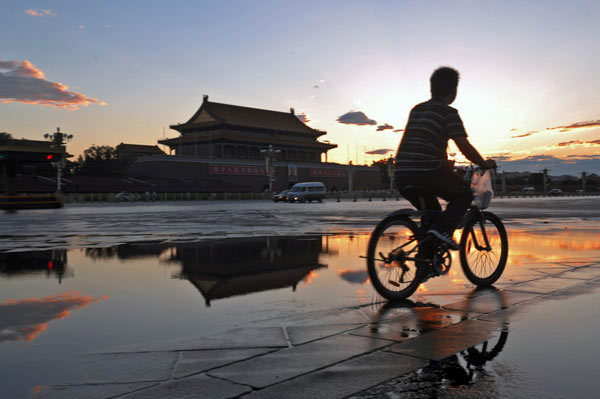
Environmental experts say fines on pollution should be harsher on businesses than individuals. Lu Yan / Xinhua |
Violators of Beijing's air pollution rule may see penalties above 1 million yuan
Beijing is weighing whether to remove its upper limit on fines for violating air pollution regulations next year.
The Beijing government released its second draft of the regulation on Sept 25, scrapping the 1-million-yuan ($163,396) limit and adding five categories of illegal behavior to a list of those for which fines will be doubled.
If the draft is approved, it means that certain actions, such as barbecuing food out in the open and discharging more vehicle exhaust than allowed, may result in heavier fines than currently applied, while serious breaches of regulations may exceed the current 1-million-yuan upper limit.
The new regulation is expected to be implemented in early 2014.
Many polluters have found that obeying pollution regulations is more costly than paying the fines, and the new regulation is an attempt to correct this situation, said Wang Delin, vice-chairman of the Legislative Affairs Committee of the Beijing People's Congress.
Chai Fahe, vice-president of the Chinese Research Academy of Environmental Sciences, said that any increases in penalties should be harsher on businesses and more tolerant of individuals.
"It is laudable that the fines have generally become tougher in the second draft of the regulation, but I don't agree with the item stating that polluting enterprises that fail to relocate or shut down as required will not be subject to a doubled fine," Chai said.
The number of clauses in the second draft now stands at 130, while the original issued in July had just 96.
In the first draft, fines would be doubled for those violating a regulation more than twice, with an upper limit of 1 million yuan. Eight exceptions were given to this rule.
The new draft, however, has reduced from eight to three the number of circumstances in which a doubled fine can be avoided, while canceling the upper limit.
In other words, illegally barbecuing food in the open air or dismantling the pollution control devices on motor vehicles without permission may result in doubled fines with no upper limits.
"It is encouraging that open air barbecuing may face much higher fines than the previous upper limit of 20,000 yuan, because such acts greatly affect the air quality nearby," said 28-year-old Wang Yichen, a resident of the capital.
Wang said there are at least 10 restaurants in a street about 500 meters away from her home on the third floor of a residential building. All of them offer open-air barbecue food in the summer.
"The smoke coming from that street chokes my family so much that we never open our windows at night in summer time," she said.
Rights and responsibilities
Another highlight in the second draft is a section dedicated to the responsibilities of the government, polluting enterprises and the public, and also the environmental rights of the public.
According to the draft, the public has the right to acquire information about air quality, and to take part in the monitoring and protection of the ambient air.
Residents can ask for information and data on pollution emergencies, the control of exhaust emissions, punishments handed down to local enterprises and so on, from all levels of the capital's government bodies.
Residents may report polluting behavior to relevant government bodies. Those affected by pollutants may ask the polluters to abide by their responsibilities, eliminate the hazards and compensate for any damage caused. They may even institute legal proceedings through the courts if needed.
"This is a breakthrough because it's the first time the public's detailed environmental rights have been officially mentioned," said Ma Yong, director of the supervision and litigation department at the environmental legal service center of the All-China Environmental Federation, an environmental NGO supervised by the Environmental Protection Ministry.
However, experts on environmental laws and regulations who participated in the creating the draft pointed out that there remains some uncertainty as to how these rights will be exercised in reality.
During the discussion of the draft, some experts suggested that penalties should be calculated on the basis of the number of days on which an infringement occurred, rather than the number of times that a rule was broken. However, this suggestion was not adopted in the new draft.
"Calculating penalties by day is actually more of a principled item than removing the upper limit for fines because the previous 1-million-yuan limit may already be hard enough to reach when the regulation is being implemented," Ma said.
However, he said that the Environmental Protection Law, which is also currently being amended, has included penalties calculated by day in its draft, and such rules may also be added to the air pollution regulation in the future.
wuwencong@chinadaily.com.cn

Copyright 1995 - . All rights reserved. The content (including but not limited to text, photo, multimedia information, etc) published in this site belongs to China Daily Information Co (CDIC). Without written authorization from CDIC, such content shall not be republished or used in any form. Note: Browsers with 1024*768 or higher resolution are suggested for this site.
License for publishing multimedia online 0108263 Registration Number: 20100000002731