Comments
  Print
Print  Mail
Mail  Large Medium Small
The Chinese government has made strenuous efforts to protect wildlife and create a sustainable environment, said China's UK Ambassador Liu Xiaoming.
"In recent years, China has placed greater emphasis on wildlife protection and enforced stricter measures," Liu said in a recent Reuters article.
Liu told his own story of how Liaoning province, where he is from, has returned farmland to the forests, and restricted many barren mountains areas to encourage reforestation.
"We have put in place a full range of rules and regulations with the Law of the People's Republic of China on the Protection of Wildlife and related forestry laws as the centerpieces," the ambassador said.
In 1988, China's Law on the Protection of Wildlife went into effect, laying down basic rules for the conservation of rare and endangered species, as well as the protection, development and rational use of wildlife to safeguard the ecological balance.
The government also placed 256 species on a national protection list in 1988, which made it illegal to kill or sell animals that were on the list.
Since then, China has built a complete legal framework for protecting wildlife, with a series of laws and regulations at both the central and local levels.
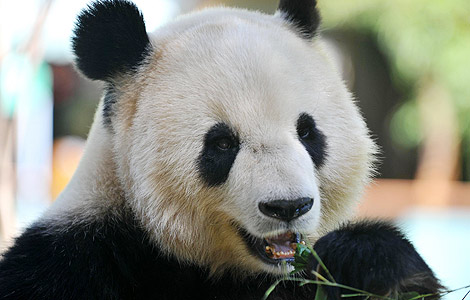
Liu explained, "China has set up special agencies for wildlife rescue, breeding and release. These include breeding bases, zoos and wildlife reserves of which the panda center near Chengdu has become world-famous."
China has invested more than 400 billion yuan to preserve natural forests and develop reforestation, he added.
According to official figures, China has successfully maintained stable populations of 230 endangered species through artificial breeding.
Internationally, China has joined the Convention on International Trade in Endangered Species of Wild Fauna and Flora and signed inter-governmental agreements on wildlife conservation with a number of countries.
With this multi-pronged approach at work, populations of endangered species in China have stopped declining and have started to recover, Liu said.
For example, only seven crested ibis' were known to exist in 1981, but there are now over 1,700. There were about 300 Chinese alligators in the 1980's, and now the number has exceeded 10,000. Przewalski's horses and Pere David's deer, previously believed to be extinct, have now reestablished their populations in the wild.
Furthermore, many social forces have joined the cause. NGOs such as China Wildlife Conservation Association, celebrities, businesses, volunteers and the media have all come on board either through campaign efforts or making donations.
Liu stressed, "In China today, any report about environmental destruction and animal abuse on the Internet will arouse indignation and invite harsh criticism from the public."
The support from the public has laid a solid foundation for wildlife conservation in China.
In spite of the progress, Liu also noted, "We are aware that China still has a long way to go." Some wildlife species still remain on the verge of extinction.
In fact, killing, poaching, smuggling and illegal trade in wildlife products are reported from time to time. But, he said, "What is encouraging is that China has taken very firm steps, and will continue to do so in the future."

 Coreopsis in full bloom in Yunnan
 A blooming success in Tian'anmen
 Li praises foreign experts for contribution
 Reception held to mark National Day
 International carnival parade held in S China
 Railway to carry 10m holiday passengers
 Premier Li meets with Friendship Award winners
 Military drill conducted in South China

Copyright 1995 - . All rights reserved. The content (including but not limited to text, photo, multimedia information, etc) published in this site belongs to China Daily Information Co (CDIC). Without written authorization from CDIC, such content shall not be republished or used in any form. Note: Browsers with 1024*768 or higher resolution are suggested for this site.
License for publishing multimedia online 0108263 Registration Number: 20100000002731