


The flowing colors of 798 art district
Media attention
Xu took photographs of Beijing's hutong in the late 1980s and started hutong tourism in the Shichahai area of the capital.
In 2002, he rented a 1,200 square meter space at 798 and set up the 798 Space Gallery. He invested more than 1 million yuan on establishing this, but his lease was only for about three years.
 |
|
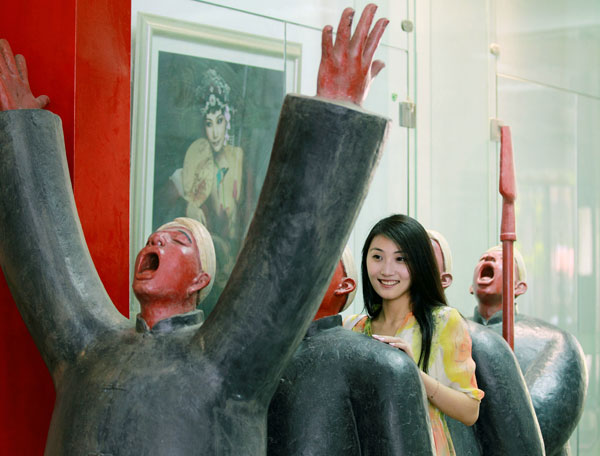
An exhibition depicting farmers' lives is staged at the 798 Art Zone this summer. Provided to China Daily |
From the start Xu positioned 798 Space as a venue mainly for contemporary art along with some other high-level commercial and cultural activities.
When Xu and Huang organized the Dashanzi International Art Festival in 2004, artists predicted it was inevitable that the 798 district would become like the SoHo area in New York. At the time, they tried hard to turn 798 into a purely cultural space and platform by recommending the arrival of good galleries and institutes.
As 798 has attracted media and public attention, both at home and abroad, it has also become another cultural landmark in Beijing.
Li Xiangqun, a professor at the Fine Arts School at Tsinghua University, submitted a proposal on "retaining an old industrial architectural heritage, retaining a developing art district" to Beijing Municipal People's Congress during the two sessions in 2004.
As a result, the 798 Art Zone received a great deal of attention from the Chaoyang District Government and the Beijing Municipal Government. Coordinating with the Seven Star Group, the Chaoyang government set up the 798 Art Zone management office.
After the office was established, the Chaoyang government invested 120 million yuan on the overall planning of 798.
Roads were built and foundations dug but then, for a year in 2008, all this had to take a back seat with the buildup to, and arrival of, the Beijing Olympics.
Zhang Guohua, executive vice-president of the 798 Art Zone Administrative Committee, regards the zone's rise as an inevitable phase for the cultural sector along with China's social development.
He admits that today's 798 is no longer the ideal place for the creation of art, or the place to display it. "We could attempt to slow the pace of commercialization," he says. "Now, only art-related businesses, such as galleries and design companies, are allowed to settle in the zone."










Registration Number: 130349


