


Solution to growth of new-energy firms blowing in the wind
 |
|
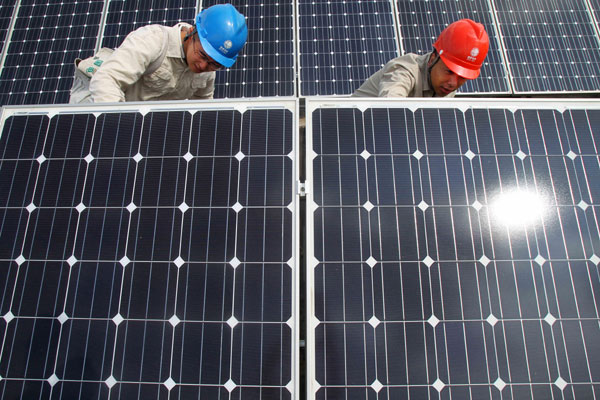
Workers from a power grid company check a solar power facility installed on the roof of a residence in the city of Nantong in Jiangsu province. [Photo by Xu Congjun / for China Daily] |
The central government has permitted preparatory work for construction of several 500,000 kw conversion stations in cities such as Baicheng and Songyuan, but the project is still awaiting official approval.
"We earnestly hope that the central government will help us build an extra-high-voltage transmission line to carry power from Jilin to North and East China," said Zheng.
Compared with the power grid, wind power projects have a much faster examination and approval procedure and a shorter construction period. That means the development of the power grid has been unable to keep pace with the growth of wind farms.
To ensure that construction and operation are in step, wind farm developers have increased preliminary communications with power grid companies regarding their plans for wind energy projects.
 |
"In the past, China's power grid was designed to serve conventional energy resources such as coal, but in the future, it should be changed to serve new energy," said Zheng. "High-level national officials must be farsighted when developing new energy and make systematic adjustments to the relevant technologies, policies, pricing systems and the power grid."
In addition to transmitting wind-generated power to other regions, Jilin is also trying to increase its own electricity consumption by using curtailed wind power for heating. Datang Xiangyang Wind Power Generation Co is currently testing a heating station in Taonan in northwestern Jilin.
The station replaced one coal-fired boiler, which had a generating capacity of 20 metric tons of steam an hour, with nine electric thermal storage heaters, which consumed 27 million kilowatt-hours of curtailed wind power during a five-month heating season, a move that saved 8,000 tons of coal and reduced carbon dioxide emissions by 35,000 tons.
Price anomaly
Despite significant environmental benefits, the station lost 10 to 20 million yuan every year because the residential heating price in Taonan remained at around 27 yuan per sq m, while the cost of generating heat using electricity was much higher, said Zhang Xuezheng, Party secretary of Datang Xiangyang Wind Power Generation Co.
Moreover, the company had to generate heat with electricity purchased from the State Grid Corp at an average price of more than 0.5 yuan per kWh, almost the same as the post-tax price of the company's on-grid wind power.
"The government compensated our company by allowing us to produce more electricity, so the profits from the generation of wind power just about covered the losses we incurred from supplying heat," said Zhang.
He said that only when the government breaks the constraints on the prices of electricity and heating, will renewable energy companies be willing to fully develop public interest projects, such as the use of curtailed wind power to replace coal-fired heating.
|
Seeking to reduce air pollution,Beijingmunicipal government has decided to cut coal consumption to 15 million metric tons by 2015, from 23.3 million tons in 2012, and to less than 10 million tons by 2017.[Full story] |
Beijing plans gas-fired future to solve problem China will reduce its consumption of coal and gradually increase the use of natural gas during the next few years, according to the Airborne Pollution Prevention and Control Action Plan (2013-17), which was released by the State Council on Thursday. Total energy consumption is measured in tons of coal, irrespective of the method of generation. In 2011, China's total energy consumption was 3.48 billion metric tons of coal, out of which coal consumption contributed 68.4 percent, while natural gas contributed just 5 percent, according to the National Bureau of Statistics.[Full story] |
|
China's total energy consumption, measured in tons of coal, was 3.62 billion metric tons in 2012, rising from 1.7 billion tons in 2003. Meanwhile, non-fossil energy accounted for 9.6 percent of total primary energy consumption and will grow to 15 percent by 2020, according to the National Energy Administration.[Full story] |
 |
- New-energy vehicle policy shifts gears
- New energy summit takes place in Chengdu
- Sino-French co-op in new energy
- New energy vehicles await fuel injection
- Low charge in new-energy initiative
- Is wind power running out of puff?
- China to focus on developing biomass, solar power
- SOEs dominate China's wind power projects
- China tops world in wind power, hydropower capacity
- Exhibition Special: The world's wind power industry gathers in Beijing















Registration Number: 130349


