


Tin city explores economic shift
Maintaining the old traditions
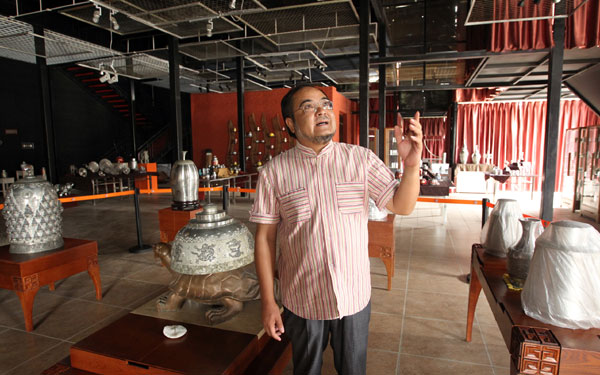
As one of the key projects for Gejiu's tin industry, Lai Qinguo's workshops, which make tin artifacts, moved to their current site in Shandian township two and a half years ago. The site covers 70 hectares and houses more than 10 workshops. The land was provided free of charge by the city government to encourage artisans such as Lai.
 |
|
Lai Qinguo displays some of his tin artifacts at his workshop in Gejiu. Zhang Wei / China Daily |
The new site is five times larger than Lai's original complex and he's relieved that traditional manufacturing techniques will continue in the "capital of tin". Revenue reached 10 million yuan ($1.6 million) last year, with a profit margin of at least 20 percent.
At Lai's workshop, around 20 artisans undertake each step in the production chain, from smelting to modeling and polishing. One tin cup takes about a day and a half to make because the soft containers can't be worked too vigorously for fear of damaging them, said Lai.
Lai frequently used the word "lucky" to describe his career. Born into a family of eight children, Lai showed an early talent for painting and a local painter volunteered to train him. However, when Lai failed to gain entrance to university in 1979, he became an apprentice at a factory that produced tin artifacts in Gejiu.
Thanks to his painting skills, Lai was ranked first among more than 200 applicants. The tin artifacts industry was suspended during the "cultural revolution" (1966-76) and only resumed at the outset of China's reform and opening-up policy in the late 1970s. The factory employed some highly skilled veterans and Lai, aged just 16, showed his knowledge and intense desire to learn from them. Four years later, he was recommended for a three-year course at Yunnan Arts College.
On graduation, Lai was assigned a teaching post at a high school for arts theory. "The difference between my career and those of other artisans is that I know the techniques in both the practical and theoretical senses," he said.
Lai is not fighting a lone battle to preserve the traditional techniques. Although many of his 300 apprentices have turned to real estate and mining, far more profitable industries, Lai still has 10 trainees who are learning to maintain the old skills.
"Now I am an old man, but what exhilarates me is the ambition of the city government to establish an industry based on the old techniques. Profits are necessary to keep the project alive," he said.
Contact the writer at huyongqi@chinadaily.com.cn
Li Yingqing and Guo Anfei contributed to this story.















Registration Number: 130349


