


Dire situations of small animals cry out for laws
 |
|
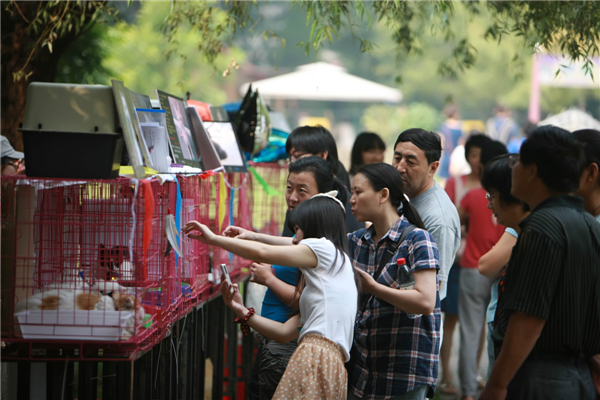
Visitors choose animals to adopt at a cat festival held in Beijing's Chaoyang Park in 2012. [Photo/Xinhua] |
Funding sources
Chinese animal assistance centers have three sources of funding. First, they garner donations from international organizations such as the Animal Asia Foundation in Hong Kong and the International Fund for Animal Welfare in Beijing. The second source is money generated by public activities, while the fastest-growing source of funding is personal donations.
Jiang said most animal assistance centers won't accept new animals when they reach maximum capacity. Theoretically, when the number of animals reaches a certain level, some will be put down to make room for newcomers.
"However, without a special small animal law to establish these protocols, putting animals down is not an option at Chinese pet assistance centers. There are no ethical or scientific plans to carry out the practice, " Jiang said.
Many animal assistance centers have taken in too many strays, which has inevitably resulted in a decline in the standard of care. "There aren't enough staff at the centers to support worming treatment, feeding and the prevention of epidemics. Most crucially, there are not many veterinarians to perform sterilizations either," said Jiang.
Beijing Human and Animal Environmental Center was originally designed to hold 200 animals, but it currently has more than 300 inhabitants. Zhang Lyuping, the chief, said staff members take numerous calls every day from people who want to leave their unwanted pets at the center. The lack of a proper pet law has led to many people abandoning their pets without shouldering any legal liability.
As the assistance centers become more familiar with pet management, stray dogs and cats are treated in a manner tailored to their own natures. "We have realized that cats should not be caged in groups because they are basically solitary creatures. From what we have seen, they are likely to suffer from infectious diseases if they are caged together," Jiang said.
Wang Zipeng, an animal rescue volunteer said the government has simplified the procedures by which nongovernmental institutions can register and set up operations to collect money from the public, which will help provide new funds to support the protection and rescue of animals.
"I think at the current stage, if we want to accelerate the legislation process, too great an emphasis on the physical and psychological rights of animals won't draw much attention from the Chinese public. We have to make people realize that their well-being is closely connected with a healthy, functioning human society," he said.
Related Stories:
Animal lovers dote on furry families at fair
- Animal lovers dote on furry families at fair
- Pixar animation expected to make a splash
- Animal lovers dote on furry families at fair
- Vbook: Wild Beijing
- London Zoo conducts annual weigh-in for animals
- About 100,000 visitors attend Chengdu animation and game fair
- Mischievous anime meets fans in China
- Chengdu stores ban bear bile

















Registration Number: 130349


