


Harvesting the homegrown
City folks are just as concerned about the food they put in their mouths, often more so than rural residents. That's why many are turning to their tiny balconies for sustenance. Eric Jou reports on a growing trend.
Imagine growing organic lettuce, tomatoes and cucumbers all without pesticides and chemicals. Then imagine being able to harvest such vegetables without even leaving home or changing out of your pajamas to go to market.
That is the promise of urban farming, of growing fresh produce in limited spaces.
As more and more people migrate from rural China to the cities, many of them wind up living in cities such as Beijing. According to the National Bureau of Statistics of China, more than 163.36 million people moved from their hometowns to other locations to work in 2012.
Such transient psychographics can be both a blessing and a curse, particularly when it comes to food.
Urbanites are eager for opportunities to reconnect to nature. And they face many challenges of time and space.
 |
|
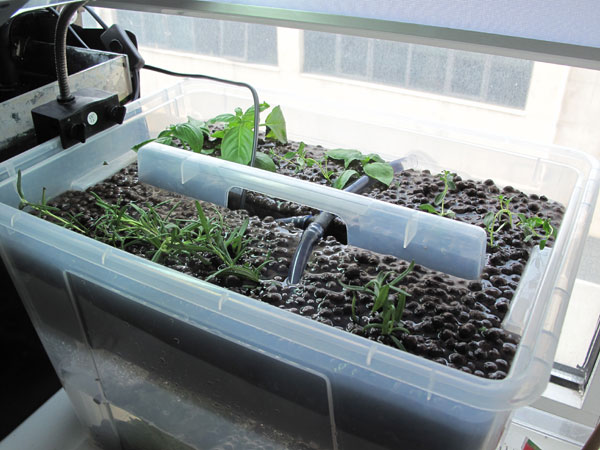
A simple aquaponics setup is balcony farming with fish, a tank, a water pump, and a second layer above the tank where the plants are grown under a light source. Eric Jou / China Daily |
Urban farming is basically about growing produce and food in an environment with limited space, and it is slowly gaining popularity in Chinese cities.
Dannan Hodge, co-founder of urban farming company High Rise Homestead in Beijing, says it is a popular concept with a lot of benefits.
"You know what's going on with your food, there are no pesticides or herbicides - nothing that will negatively affect your health," says Hodge. "A lot of farmers who do traditional farming have vegetables they grow for sale and vegetables they grow for their own consumption. They grow them differently because they know the chemicals they use are hazardous."
High Rise Homestead works to help Beijing residents to "grow their own" at home. They supply products such as frames that train plants to grow upward, kits for growing produce on inclined surfaces and vertically stacked planters. Windowsills and balcony gardens are all in the picture.
Hodge says the most popular plantings on balconies are vegetables because they're simple to grow, even strawberries, cherry tomatoes and gourds.
"It really does inspire people to eat healthy - you can't grow a bag of chips," she says. People - especially children - get excited to see their own food grow, food that they planted and will harvest themselves.
"There is also a health benefit where people are inspired to become more conscious consumers," she says.
High Rise Homestead is working to cut down the supply chain by sourcing materials locally.
Elizabeth Jane Ashforth says the idea of growing food indoors is great. Ashforth is a doctor of marine biology who tried to build her own sustainable system within her apartment in Beijing, and she says growing food indoors can create wonders.
"People in general have lost a connection to where their food comes from and how difficult it is to grow actually," says Ashforth. "Doing something like this adds a bit of greenery to your home, it just makes you feel connected to the environment and that can only be a good thing."
American Tim Quijano has recently started giving DIY lessons on setting up aquaponic ecosystems.
Aquaponics is similar to a hydroponic setup where plants are grown in water, except aquaponics introduces fish into the equation.
A simple aquaponics setup involves a fish tank with possibly edible fish, a water pump, a second layer above the tank where the plants are grown and a light source. The fish eat and create waste and the pump siphons the water to the upper layer to fertilize and water the plants. The water then drains back into the lower tank.
According to Quijano, some aquaponics setups can support edible fish such as tilapia.
A fellow with the Princeton in Asia organization, Quijano says his main passion is working on environmental issues. Quijano started working on aquaponics during a move from one apartment to another.
"What got me started was that I had this fish tank in my apartment that I moved into this year and I thought how I could do something fun with this," says Quijano.
"I like having new projects and learning new things. It just hit me one night that I could learn something about aquaponics," adding that he's spent "many hours on Youtube researching growing my own food".
China has a rich history and culture of being self-reliant when it comes to food, says Quijano. Pointing out recent food safety scares and the migration of workers from the countryside to the cities, Quijano says that there is a wealth of agriculture knowledge in Chinese cities.
"I live in a large apartment complex and the grannies that are there, they have set up little makeshift greenhouses with a stick of bamboo and a tarp. There's so much knowledge and there's such an appreciation for it."
Aquaponics newbie Andrew Morrissey attended one of Quijano's workshops on a whim after seeing an online posting about it.
"I came to see what it was about and whether I could do it at home and grow some tomatoes for the family and make me more useful," says Morrissey,
"I don't know about farming but I am never going out and buying vegetables again but if I can get something going and it works. If it can get bigger over time with a bit of experimenting it can be a lot of fun. Maybe I can get some edible fish. It would make the wife very happy."

















Registration Number: 130349


