Comments
  Print
Print  Mail
Mail  Large Medium Small
If China has learned anything from its encounters with the West, it's that the country's future should rely on its multicultural talents, connecting East to West with their language skills and cultural dexterity.
The nation now boasts the world's second-largest economy, and those talents represent a soft power it can hold onto, said Zhu Xiangyuan, scholar and former member of the Standing Committee of the National People's Congress, China's top legislative body.
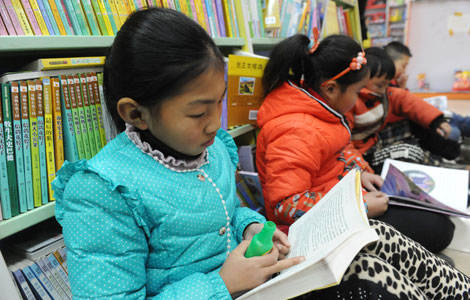
Nowadays many Chinese students start learning English and studying language-based cultures and societies in primary school. As they grow up, they learn about Chinese classics, such as works by Confucius and Lao-tzu, poetry and verses, as well as iconic Western discoveries like Isaac Newton's Principia, Charles Darwin's natural selection theory and Karl Marx's analysis on capitalism. They have inherited a love for Chinese music, theater and crafts, but at the same time develop a penchant for US Billboard hits, hip-hop and Hollywood blockbusters.
They have an edge in cross-cultural understanding, compared with their Western counterparts, who seldom study an Oriental language at a very young age. These future multicultural talents know how to better preserve and identify their traditional wisdoms, said Zhu.
China's cultural encounter with the West
China adopted its "learn from the West" attitude after the Opium War in 1840, which forced the Qing Dynasty to open up to a fast-changing world and unleashed a painful period filled with struggle to catch up with the West.
At the same time, Chinese civilization preserved its own philosophy and values, which had shielded this old civilization from Western culture and influence.
China's philosophy peaked during the Spring and Autumn Period (770-476 BC) and Warring States Period (475-221 BC), when the most influential sages in Chinese history – including Confucius, Lao-tzu and Mencius – publicized their theories concerning the government of a state.
China, despite the changing dynasties, remained the most prosperous empire until the early Qing Dynasty (1644-1911) and kept its mystery from other parts of the globe.
For most of the time before the Opium War of 1840, China governed itself with its traditional wisdoms, which the followers of Confucius had passed down from generation to generation. Confucian scholars were strictly selected by exams to become officials, forming the bedrock of China's meritocracy. Sporadic Western cultural inflows were never able to challenge the authority of these traditional wisdoms. Even Buddhism was localized to survive in China.
The Tang Dynasty (618-907), a wealthy empire that flaunted its cultural prosperity and military prowess at home and abroad, is regarded as the most open-minded among China's many dynasties, with a huge inflow of foreign students.
The Yuan Dynasty (1279-1368), created by the Mongols, was also well-known in the West because of Marco Polo's travels, which chronicled this Venetian merchant's adventures in Asia and his meeting with the Yuan Emperor, Kublai Khan.
Italian missionary Matteo Ricci's arrival in China, during the later Ming Dynasty (1368-1644), marked a brief but lively introduction of Western philosophies and technology, which was halted in the early Qing Dynasty. This encounter echoed the vast social changes in Europe, which began to embrace new ideas from the Renaissance. This was the last peaceful encounter of the two sides before Britain invaded China with its opium and weapons in 1840.
Chinese intellectuals began to look to the West for a panacea to China's social problems after 1840. They tried to model the British Constitutional Monarchy in a failed attempt, starting 1898. They were inspired by French Enlightenment figures for a blueprint of a republic in the early 20th century, when Marxism was also introduced to China.
China accelerated its attempts to study the West after the reform and opening-up policy was introduced in 1978, to end its planned economy. Business opportunities and cultural exchanges have flourished since then, creating a niche for people who know how to handle cultural and linguistic diversities.
Establishing English as a compulsory course and teaching Western culture are China's response to keeping up with a diverse world.
(Translated by Zhao Siyuan)


Copyright 1995 - . All rights reserved. The content (including but not limited to text, photo, multimedia information, etc) published in this site belongs to China Daily Information Co (CDIC). Without written authorization from CDIC, such content shall not be republished or used in any form. Note: Browsers with 1024*768 or higher resolution are suggested for this site.
License for publishing multimedia online 0108263 Registration Number: 20100000002731