Knowledge of the past
|
 |
|
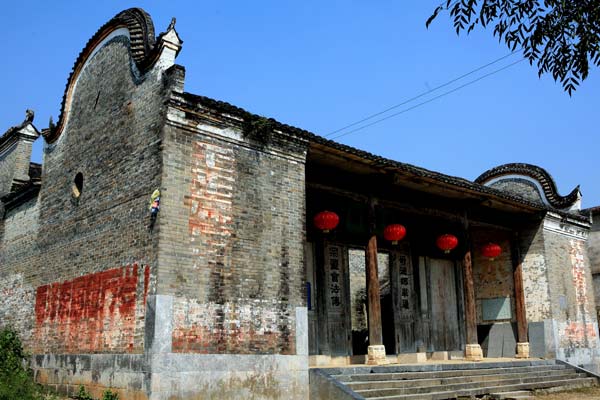
The Zhou family temple pays tribute to the village's past glories. Huo Yan / China Daily |
A big Zhou family temple, built with stone bases, gray bricks, wooden pillars and rafters as well as black earthenware tiles, is perched near the bridge on the village side of the river.
The rundown wooden frontage indicates the temple has not been repaired for a long time.
Zhou Zhihua, gatekeeper of the temple, says: "Five yards of the temple were demolished in the 'cultural revolution'. What remains is only the classroom yard."
The temple, once covering an area of 1,200 square meters, was a preparatory school where villagers took the imperial exams from 1888. There were dorms, libraries, classrooms, canteens, gardens and auditoriums.
The temple was the location of many academic achievements with the village enjoying great success in the imperial exams.
The imperial exams were the main channel for the Chinese government to recruit talent according to their academic merits from the Han Dynasty (206 BC-AD 220) to 1905.
Testing candidates' knowledge of Confucian classics, writing, military strategy, civil law, revenue and taxation, agriculture and geography, the exams were given on four levels — county, provincial, national and palace.
In the 150 years before 1905, when the imperial exam was abolished, out of the village's 158 families, eight people passed the palace exam, nine passed the national exam, 28 passed the provincial exam and hundreds passed the county exam.
|
 |
|
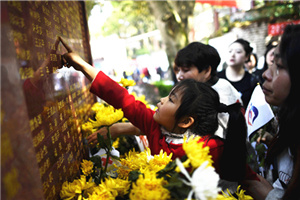
Zhou Chonghui, 11, is from a family that had four generations of top academicians throughout the Qing Dynasty (1644-1911). Huo Yan / China Daily |
Half of the people from Jiangtou who passed the exam became teachers in higher education institutes. The other half became officials of various levels, famous for their honesty and uprightness.
These model villagers spent most of their wealth financing schools in the village and refurbishing their residences.
Their names and titles are not only worshipped in the temple but also appear on the commemorative plaques hung on the gates of their descendants' residences.
You can see from the wooden boards on the gate how many important scholars or officials came from each family.







- Probe launched into illegal sales of eagles on livestreaming sites
- CMC to standardize benefits for senior military officials
- Vice-premier calls for sense of mission in poverty reduction
- Xi'an-Chengdu high speed railway enters inspection phase
- More air routes link places along Belt, Road