A growing thirst for water safety
|
 |
|
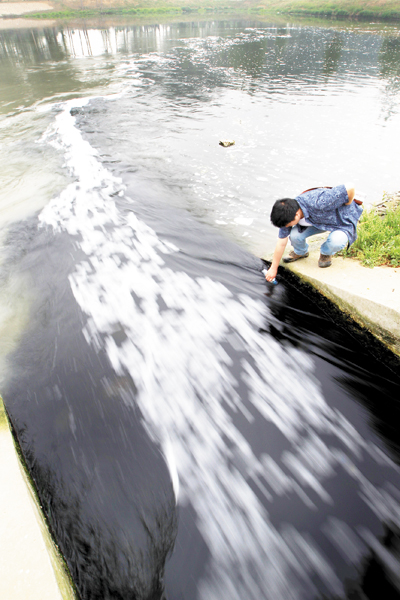
The Jialu river in Zhengzhou, capital of Henan province, has been heavily polluted by the urban waste. Only about 40 percent of China's groundwater qualifi es as a source for drinking water, according to the Environmental Protection Ministry. |
Experts say greater monitoring and better facilities needed to ensure quality, report Wu Wencong, Jiang Xueqing and Tang Yue in Beijing.
The issue of polluted groundwater in China has once again bubbled to the surface. Such rising concern follows in the wake of a report claiming that only 22 percent of underground water in the densely populated North China Plain qualifies as drinking water.
In February, claims washed over social media sites that tainted water from paper mills and chemical works in Weifang, Shandong province, was being pumped underground, thus polluting groundwater sources.
However, experts and officials said the problem can only be solved by greater investment in monitoring systems, stricter laws and an upgrading of outdated quality standards that have not been amended for more than 20 years.
Many experts pinpointed a lack of monitoring sites and their inadequate facilities as one of the key factors hindering the government's efforts to tackle groundwater pollution.
"Out of fewer than 25,000 monitoring sites managed by all levels of the water resources departments, only about 10 percent are equipped with facilities to test water quality, while the rest can only monitor water quantity," said Chen Ming, head of the water resources department at the Ministry of Water Resources.
Only about 40 percent of China's groundwater qualifies as a source for drinking water, according to the Environmental Protection Ministry's 2012 Environmental Conditions Report, published on June 4, which examined 5,000 pockets of groundwater in 198 cities.
The number of qualified sources was much lower on the plains, and fell to around one-fifth on the North China Plain, which includes the provinces of Henan, Shanxi, Hebei and Shandong, plus the municipalities of Beijing and Tianjin.
"It's not that the government has ignored pollution in the past," said Chen. "The reason for the sharp contrast is that pollution has only emerged as a problem in the past 30 years, as a result of the country's rapid development."
He said recharge - polluted surface water that sinks into the ground - is a major cause of groundwater pollution, because most of the exploitable groundwater is connected to surface water.
The major sources of pollution include urban domestic refuse, leaks from industrial pipelines, the illegal discharge of sewage, and the widespread use of pesticides and fertilizers.
The discharge of untreated industrial sewage nationwide reached almost 16 billion metric tons in 2009, but wasn't included in the official data, according to research conducted by Ma Zhong, head of the School of Environment and Natural Resources at Renmin University of China.
Ma suspects that at least part of the untreated sewage has been dumped underground.
In addition to the inadequate facilities at many monitoring stations, there simply aren't enough of them.
"During the 1970s and 1980s, groundwater was still untainted in many regions because of limited human activity. There was no large-scale exploitation of groundwater. Therefore, only a small number of monitoring stations were required for groundwater resource investigation and assessment," said Gao Cunrong, director of the department of groundwater monitoring at the China Institute of Geological Environmental Monitoring.
More than 20,000 national-level monitoring stations will be built or upgraded in 31 provinces by the Ministries of Water Resources and Land and Resources, and more than 50 percent of those stations will be equipped with facilities to test water quality, Chen said, without giving a completion date for the project.





- 650 million trips expected during National Day holiday in China
- Coming-of-age: Females turn tough soldiers after military service
- Wild giant panda spotted in SW China
- Former Chinese securities regulator's deputy chief faces graft investigation
- Pieces of China's oldest stone arch bridge repaired