Space lotuses to touch down in Shanghai
|
 |
|
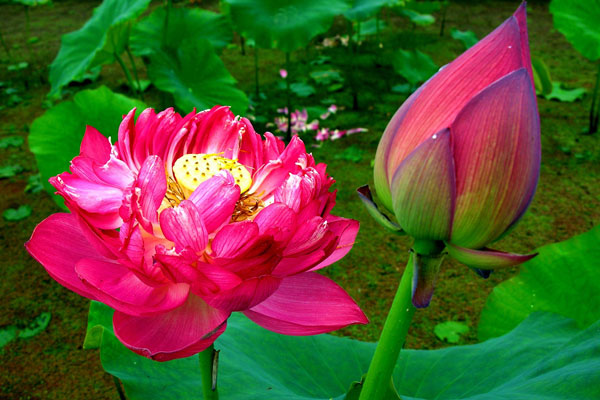
The Space Red Flag, a variety of the "space lotuses", which are said to be better than the ordinary type. PROVIDED TO CHINA DAILY? |
Shanghai's largest display of "space lotus" flowers in history opens this month.
The 50 flowers of 13 varieties grown from seeds that traveled into space will be on show at Guyi Gardens on June 28.
"The space lotuses will be a highlight, as many people are excited about the recent space mission," said Sun Jia, spokeswoman for the 500-year-old gardens in Jiading district. Sun added the best time to enjoy the show will be the full bloom period, which is expected to be near the end of July.
The venue has exhibited space lotuses before, but never so many varieties, as they are rare due to the complicated cultivating process, she said.
The most famous in the show will be the No 36 Space Lotus, a white variety from Jiangxi province's Guangchang county, that was successfully cultivated after three trips to space.
A total of 442 seeds were placed on a recoverable satellite that spent more than 355 hours in orbit in 1994. Selected seeds were then carried on Shenzhou IV in 2002 and on another recoverable satellite in 2006.
Xie Keqiang, director of the Guangchang White Lotus Research Institute, said research showed more effective mutations in seeds on the first satellite flight as opposed to those on the Shenzhou IV trip.
"The purpose of sending seeds into space is to make use of high-energy particles and radiation to induce mutation," he said. "But the manned Shenzhou IV had a life-support system that weakened the radioactive effect."
Not all seeds mutates, as cosmic radiation is random — it causes both positive and negative effects, which is why some seeds need several space trips and ground experiments, Xie added.
It can take at least five years to cultivate a new variety and the process can last more than a decade, he said.
Scientists first sent seeds into space in 1987.
Scientists say radiation-induced mutation is a natural and safe way to breed new crop varieties, given that it does not involve artificial genetic modification.
Tao Dejun at Yameijia Aquatic Flowers in Chongqing's Dazu district said about 30 percent of lotus seeds survive cosmic radiation. These are carefully screened to eliminate genetic drawbacks.
Only those with bigger, more colorful and long-lasting flowers are chosen for mass cultivation, he said.
Yameijia will supply the Guyi Gardens show with the Space Red Flag, Space Apsaras and Butterfly Dance varieties.
"The Space Red Flag, for example, has a very large flower, which could be 40 centimeters long in diameter," Tao said. "It's more durable. Ordinary lotus flowers in a pond usually bloom for two months, but a pond of Space Red Flag can last from late May to early November, which obviously has more ornamental value."
Xie said that the benefit of cosmic breeding is the cultivation of plants with a higher seed yield, more nutrition and a high level of resistance to disease.
The average seed yield of the No 36 Space Lotus is about 6.67 kilogram a hectare, more than twice the conventional ones, he said.