Cushion added for life in orbit
|
 |
|
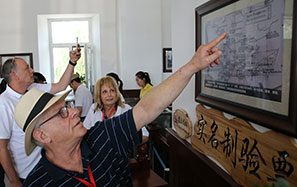
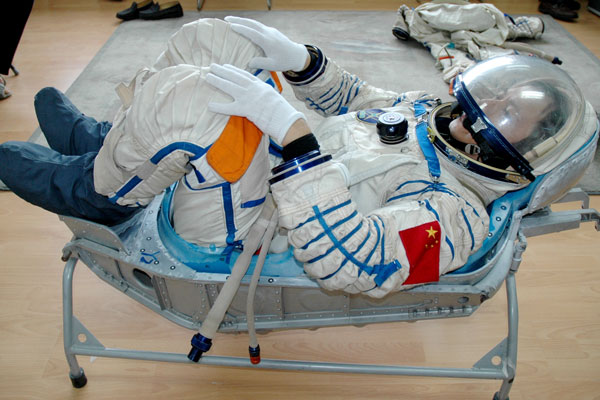
Cui Guoqi, a professor at Tianjin University, demonstrates tailor-made cushioned seats for Chinese astronauts. Wang Qing / For China Daily? |
Those concerned about astronauts' living conditions need not worry, as scientists from Tianjin and Shanghai have devoted years to designing high-tech equipment to make life in space easier.
Cui Guoqi, a professor at Tianjin University, is the director of one of China's first research centers in rapid prototyping, more commonly known as 3-D printing. Cui's team has spent 15 years developing tailor-made cushioned seats for Chinese astronauts.
The seat, made of 70-millimeter-thick composite materials, looks like a bathtub in shape.
"The seats are used during launch and landing to protect the astronauts, especially their backbones, from being hurt by the jolt during acceleration," he said.
"We collect physical data from astronaut candidates, like the measurements of their spacesuits, but the seats require much more data than the suits. And with more precise data, the seat will be better fitting and able to defuse more impact."
Cui said the number of data that is collected has increased from tens of thousands to hundreds of thousands as they've improved the precision of the seats.
"Every seat should be tested by the astronaut in person and undergo adjustments to make it more precise. My colleagues and I are more familiar with their physical data than their family members," he said.
Cui said Liu Yang, China's first female astronaut, told him the seat was "safe and well-suited" after she finished her space mission in June 2012.
Donghua University in Shanghai, formerly China Textile University, also helped astronauts on Shenzhou X by inventing a special diaper that is not only super-absorbent but able to dissolve ammonia and other chemicals from human waste.
Like the MAGs, or maximum absorption garments termed by NASA, the Chinese diapers have been specially named "waste collecting devices".
Led by Professor Yuan Qinhua, 72, the team has been customizing the waste device for 10 years since the launch of Shenzhou V, China's first manned spaceship lifted off in October 2003.
According to Yuan, the devices used by Shenzhou X's mixed-gender crew are not only gender specific, but also tailor-made to each astronaut's body.
And thanks to the special materials used, the device can quickly absorb human waste, deodorize, and keep astronauts dry and safe from infection.